Disclosure: some links on this page may earn us a commission at no extra cost to you. As an Amazon Associate I earn from qualifying purchases. This page is research from official manufacturer pages, not hands-on testing. Details
Four materials cover most of what hobby printers run: PLA, PETG, TPU and ABS or ASA. They differ in how hot they print, how much heat the finished part survives, how stiff or flexible it is and whether you need an enclosed printer. This guide compares them using the published technical data sheets from one manufacturer, Bambu Lab, so the numbers are measured the same way and you can see the real trade-offs.
Read this first: we have not hands-on tested any filament. The figures below are Bambu Lab’s own published values for its own filaments, tested by Bambu on standard samples. Other brands’ PLA, PETG and ABS will be in similar ranges but not identical, so use these as a reference point and check the datasheet for the spool you actually buy. Bambu itself says the values are for design reference and comparison only.
The four materials at a glance
| Material | Nozzle temp | Bed temp (with glue) | Heat deflection, 1.8 / 0.45 MPa | Tensile strength (X-Y) | Elongation at break (X-Y) | Density |
|---|---|---|---|---|---|---|
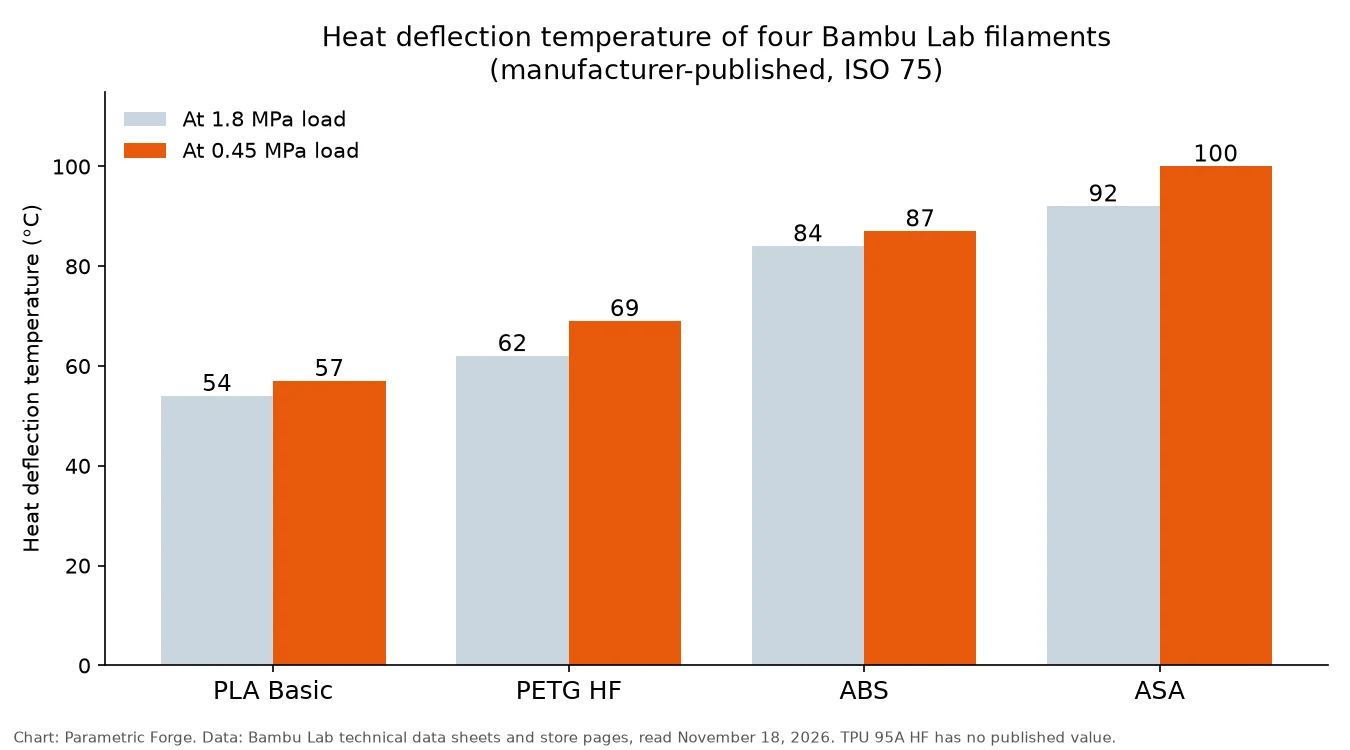
| PLA (Bambu PLA Basic) | 190 to 230 °C | 35 to 45 °C | 54 / 57 °C | 35 ± 4 MPa | 12.2 % | 1.24 g/cm³ |
| PETG (Bambu PETG HF) | 230 to 260 °C | 65 to 75 °C | 62 / 69 °C | 34 ± 4 MPa | 8.6 % | 1.28 g/cm³ |
| TPU (Bambu TPU 95A HF) | 220 to 240 °C | 30 to 35 °C | No value published | 27.3 ± 0.8 MPa | More than 650 % | 1.22 g/cm³ |
| ABS (Bambu ABS) | 240 to 270 °C | 80 to 100 °C | 84 / 87 °C | 33 ± 3 MPa | 10.5 % | 1.05 g/cm³ |
| ASA (Bambu ASA) | 240 to 270 °C | 80 to 100 °C | 92 / 100 °C | 37 ± 3 MPa | 9.2 % | 1.05 g/cm³ |
Heat deflection temperature (HDT) is the temperature at which a standard test bar starts to bend under a set load. It is a useful way to compare materials, not a safe-use temperature for your part.
PLA: the default for a reason
PLA prints at the lowest temperatures of the group (190 to 230 °C for Bambu PLA Basic) with a bed at 35 to 45 °C, and it does not need an enclosure. Bambu’s datasheet lists a printing speed below 300 mm/s and a chamber range of 25 to 45 °C. The trade-off is heat. Its published HDT is 54 to 57 °C, the lowest here, and Bambu warns that some prints deform or warp when annealed. A part left on a car dashboard or near a heater is the classic risk, though how much heat any specific part tolerates depends on its shape and load.
PLA is also the stiffest of the materials with published figures here (bending modulus 2,750 ± 160 MPa), though stiff does not mean tough. Its elongation at break is 12.2 % in the X-Y direction and only 7.5 % in Z, so layers are the weak direction.
PETG: a step up in heat and toughness
Bambu PETG HF prints at 230 to 260 °C with a bed at 65 to 75 °C. Its HDT is 62 to 69 °C, a bit higher than PLA, and the datasheet lists resistance to most oils and greases (Bambu lists the same for PLA Basic). It is slightly less stiff than PLA (Young’s modulus 1,810 ± 190 MPa against 2,580 ± 220 MPa) and Bambu reports a weaker Z direction, with tensile strength of 23 ± 4 MPa across layers against 34 ± 4 MPa along them. Bambu’s PETG HF datasheet lists oven drying at 65 °C for 8 hours before printing.
TPU: flexible parts
TPU is a different kind of material: rubbery rather than rigid. Bambu TPU 95A HF has a Shore hardness of 95A, elongation at break above 650 %, and a printing speed guideline below 200 mm/s. Bambu’s page gives a 12 mm³/s maximum volumetric speed and says it prints about 3 times faster than its regular TPU 95A in its own test (147 mm/s against 44 mm/s on a 50 mm wide test cylinder). Bambu lists 0.4, 0.6 and 0.8 mm nozzles and recommends a 220 to 240 °C nozzle with a 30 to 35 °C bed. It does not publish an HDT. The filament is highly sensitive to humidity, and Bambu recommends drying it at 70 °C for 8 hours.
ABS and ASA: heat resistance, with conditions
ABS and ASA have the highest heat resistance of the group. Bambu ABS lists an HDT of 84 to 87 °C, and Bambu ASA 92 to 100 °C. They print hotter (240 to 270 °C nozzle, 80 to 100 °C bed) and they warp more. Bambu’s ABS datasheet gives a recommended chamber temperature of 45 to 60 °C, and its store page for ASA recommends an enclosed printer.
There is a health and safety note too. Bambu’s ASA page says that at printing temperatures this filament may release harmful gases, including styrene, and recommends an enclosed printer, a protective mask for extended operation, and more ventilation, or a pause in printing, if people with asthma or respiratory conditions, pregnant women or children are present. Bambu says ABS and ASA may both release pungent odors and share the same warping tendency on large or high-infill models.
ASA is described by Bambu as an ABS variant with an added acrylate component that improves weather and UV resistance and reduces fading and yellowing outdoors. Bambu’s ASA datasheet gives no UV exposure duration, so treat “outdoor use” as a design direction rather than a guarantee.
Quick chooser from the published numbers
| If you need | Look at | Why, per the datasheets |
|---|---|---|
| Easiest to print, indoor display parts | PLA | Lowest nozzle and bed temperatures, no enclosure needed |
| A bit more heat resistance than PLA | PETG | HDT of 62 to 69 °C against 54 to 57 °C for PLA |
| Flexible, bendable or protective parts | TPU 95A | Shore 95A and elongation above 650 % |
| Parts that must survive heat | ABS or ASA | HDT of 84 to 100 °C, enclosed printer recommended |
| Outdoor parts | ASA | Bambu describes UV and weather resistance; no exposure duration published |
Which printers fit which materials
Material choice and printer choice go together. The open-frame Bambu Lab A1 and A1 mini are open designs: Bambu says the A1 mini is not recommended for ABS, ASA, PC, PA or PET, and advises against enclosing the A1. The enclosed P1S is listed by Bambu with ABS and ASA as ideal materials, and the P2S has a fully enclosed chamber.
Our A1 versus A1 mini comparison covers the two open-frame models in more detail. The buying guide explains how to pick a printer by budget.
Storing and drying filament
- Bambu recommends printing and storing filament below 20 % relative humidity, sealed with desiccant.
- Oven drying settings in Bambu’s datasheets differ by material: 50 °C for 8 hours for PLA Basic, 65 °C for PETG HF, 70 °C for TPU 95A HF and 80 °C for ABS.
- Bambu warns against using a microwave or household kitchen oven for drying. It asks for a forced-air oven with even temperature.
- Drying is a way to recover filament that absorbed moisture. It is not a substitute for sealed storage.
Filament choice is one part of a finished model. Painting and coating are a separate step, and they are not covered in the tables above. If you want a cordless sprayer or other finishing and workshop tools that sit next to a printer, see our maker tools guide. Some of those items are live crowdfunding campaigns, so check that the campaign is still open before you pledge.
Sources and date checked
- Bambu PLA Basic technical data sheet and store page
- Bambu PETG HF technical data sheet, store page and the Bambu filament guide table
- Bambu TPU 95A HF technical data sheet and store page
- Bambu ABS technical data sheet and store page
- Bambu ASA technical data sheet, store page and the ABS, ASA and PC usage guide
- Printer notes: Bambu Lab store pages for the A1, A1 mini, P1S and P2S
All sources were checked on November 23, 2026. Brands revise datasheets, so check the current version before you rely on a number. The Amazon links on this page go to printer listings sold by Bambu Lab’s official Amazon store, so check current price there. We have not added Amazon filament links because we have not confirmed official-store filament listings yet.