Category: 3D Printers

  • Best 3D Printers Under $300

    Best 3D Printers Under $300

    Sub-$300 printers have changed a lot. Several brands now sell fast, auto-leveling machines for less than the price of a mid-range phone. This guide lines up six of them from Bambu Lab, Creality, ELEGOO and Anycubic using only the figures on each brand’s own store page.

    How we compared: we have not hands-on tested any of these printers. The table below was built from the official store pages linked in the sources list, read on November 27, 2026. We only included printers whose store page showed a price at or below $299 that day. Where a spec was not on the page we read, the table says so instead of filling in a guess. Sale prices come and go, especially around Black Friday, so confirm the price before you buy.

    The shortlist at a glance

    Printer Listed price, Nov 27, 2026 Build volume Max speed Max nozzle temp Max bed temp
    Bambu Lab A1 mini $199 (store shows $219 crossed out) 180 x 180 x 180 mm 500 mm/s 300 °C 80 °C
    Creality Ender-3 V3 SE $169 (store shows $199 crossed out) Not stated on page 250 mm/s Not stated on page Not stated on page
    ELEGOO Neptune 4 $219 (store shows $249 crossed out), listed as sold out on Nov 27 225 x 225 x 265 mm 500 mm/s 300 °C 110 °C
    ELEGOO Neptune 4 Pro $239 (store shows $274 crossed out) 225 x 225 x 265 mm 500 mm/s 300 °C Not read
    ELEGOO Centauri 2 $244 (store shows $299 crossed out) 256 x 256 x 256 mm 500 mm/s 350 °C Not read
    Anycubic Kobra 4 $279 (store shows $379 crossed out) 260 x 260 x 260 mm 600 mm/s 300 °C 100 °C
    Sources: official brand store pages listed below, checked November 27, 2026. Crossed-out prices are as shown by each store and are not our estimates. Max speed is the brand’s headline figure, not a recommended print speed.

    Build space for the money

    A cheap printer with a tiny bed can be a worse deal than a slightly pricier one with more room. This table divides each printer’s listed price by its build volume. These numbers are calculated by us from the listed price and listed dimensions, rounded, and are estimates of value, not measurements of anything.

    Printer Build volume (calculated) Price per liter (calculated)
    Bambu Lab A1 mini 5.8 L $34
    Creality Ender-3 V3 SE Not stated n/a
    ELEGOO Neptune 4 13.4 L $16
    ELEGOO Neptune 4 Pro 13.4 L $18
    ELEGOO Centauri 2 16.8 L $15
    Anycubic Kobra 4 17.6 L $16
    Calculated by Parametric Forge from official list prices and build dimensions as of November 27, 2026.

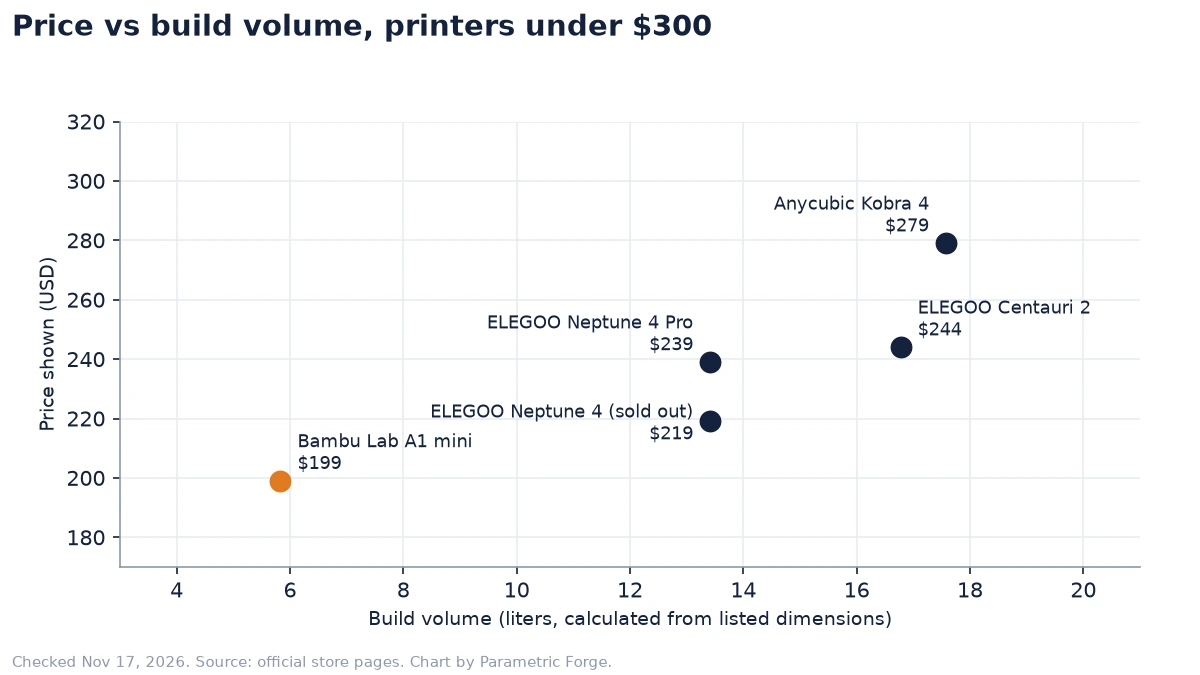
    Taking those numbers at face value, the ELEGOO and Anycubic machines offer the most build space per dollar here, and the A1 mini the least, which is what you would expect from its compact size.
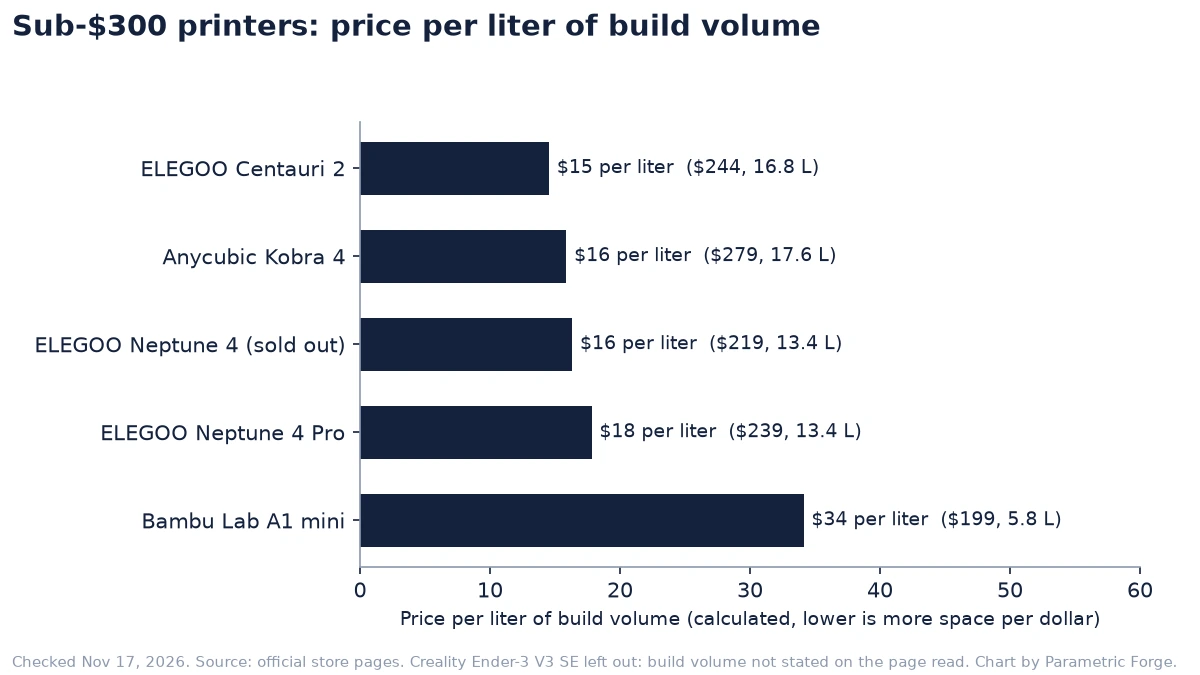
    Bar chart of price per liter of build volume for five printers under $300, checked November 27, 2026
    Chart: Parametric Forge. Prices checked November 27, 2026 from official store pages.
    Scatter chart of price against build volume for five printers under $300, checked November 27, 2026
    Chart: Parametric Forge. Prices checked November 27, 2026 from official store pages.

    What stands out on paper

    Bambu Lab A1 mini
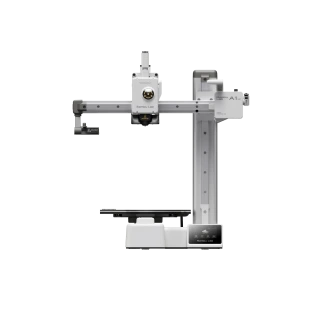
    Bambu Lab A1 mini 3D printer, official product image from Bambu Lab
    Image: Bambu Lab

    The smallest and most compact option, with a 180 mm cube, a 300 °C hot end and an 80 °C bed. Bambu’s page lists PLA, PETG, TPU and PVA as supported and advertises a 49 dB noise level. It is the entry ticket into Bambu’s ecosystem and pairs with an optional AMS lite for multi-color, but you give up space. Our A1 versus A1 mini comparison covers it in depth.

    Creality Ender-3 V3 SE
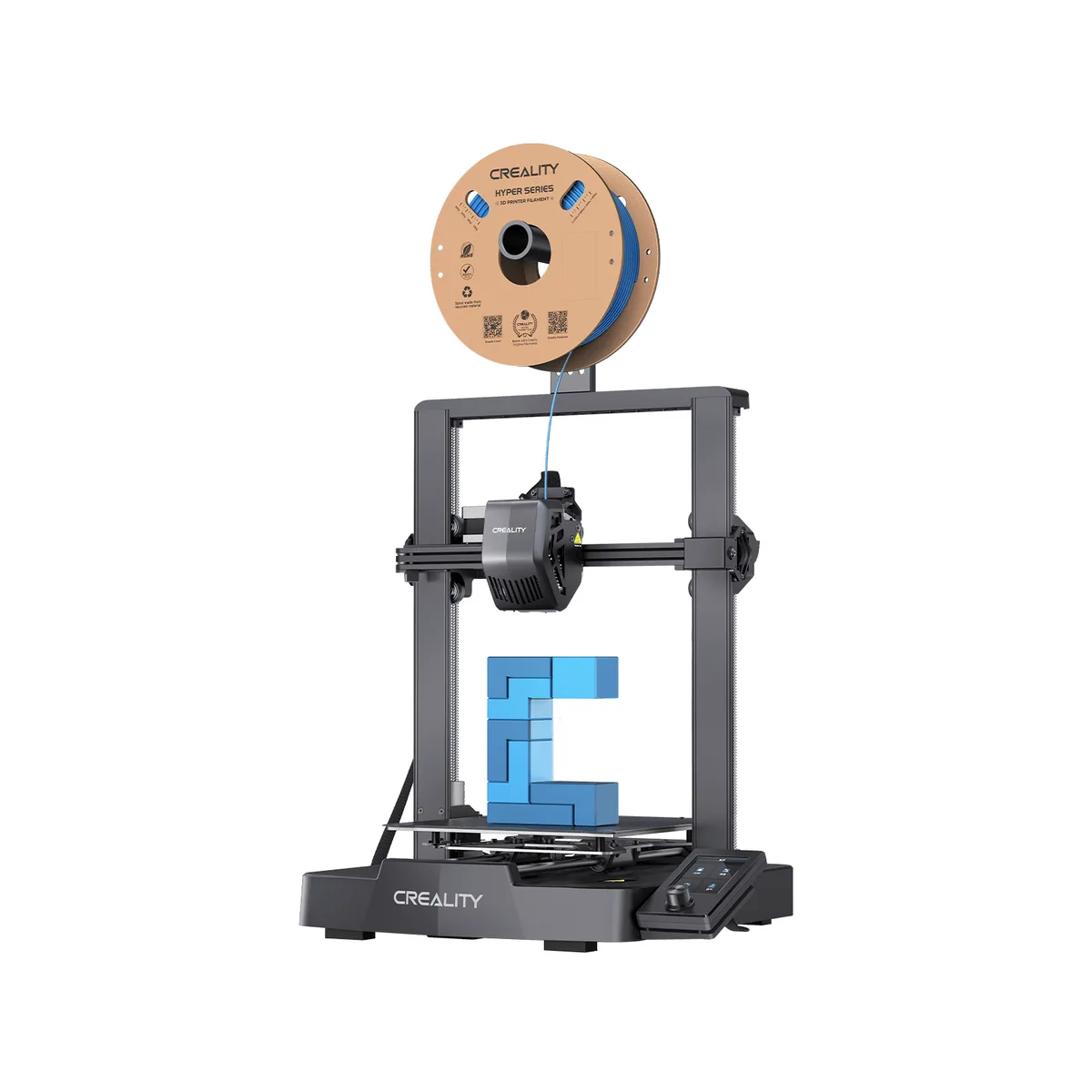
    Creality Ender-3 V3 SE 3D printer, official product image from Creality
    Image: Creality

    At $169 it is the cheapest printer in this group. The store page we read lists a 250 mm/s maximum speed, 2,500 mm/s² acceleration, a CR Touch sensor with strain sensors for leveling, a Sprite direct extruder for PLA, PETG and TPU, and dual Z-axis rods. It did not list build volume or temperature limits in the text we could read, so we left those blank rather than rely on memory. Check Creality’s page for the full sheet.

    ELEGOO Neptune 4 and Neptune 4 Pro
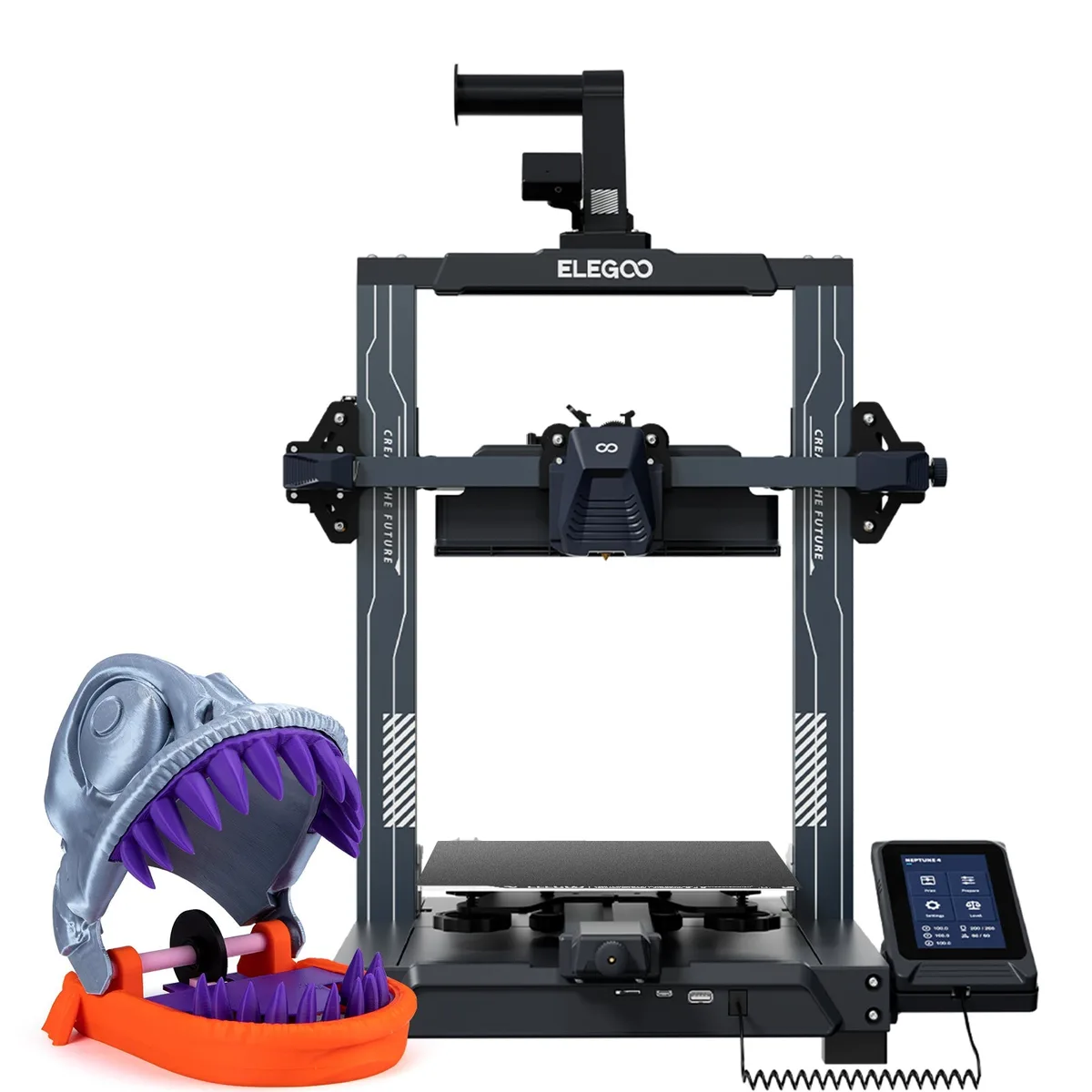
    ELEGOO Neptune 4 3D printer, official product image from ELEGOO
    Image: ELEGOO
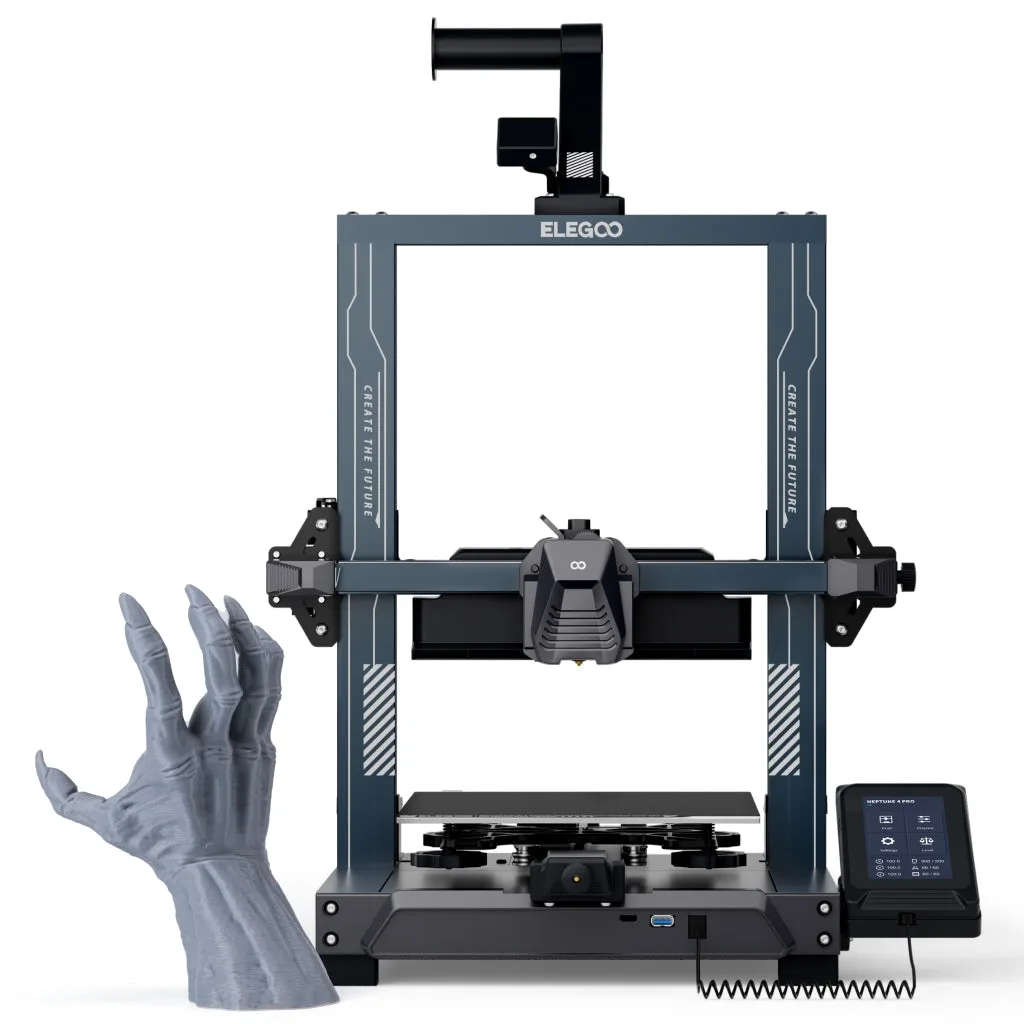
    ELEGOO Neptune 4 Pro 3D printer, official product image from ELEGOO
    Image: ELEGOO

    Note that on November 17 ELEGOO’s page showed every Neptune 4 variant as sold out, while the Neptune 4 Pro Type-C version was available. These two share a 225 x 225 x 265 mm build volume, a 500 mm/s top speed, a 300 °C nozzle and Klipper firmware, according to ELEGOO’s pages. The Neptune 4 page also lists a 110 °C bed, 20,000 mm/s² acceleration and 121-point auto bed leveling. The Pro adds a segmented heatbed, with a center zone of 120 x 120 mm and peripheral zones that activate for larger models. ELEGOO recommends 250 mm/s even though the maximum is higher.

    ELEGOO Centauri 2
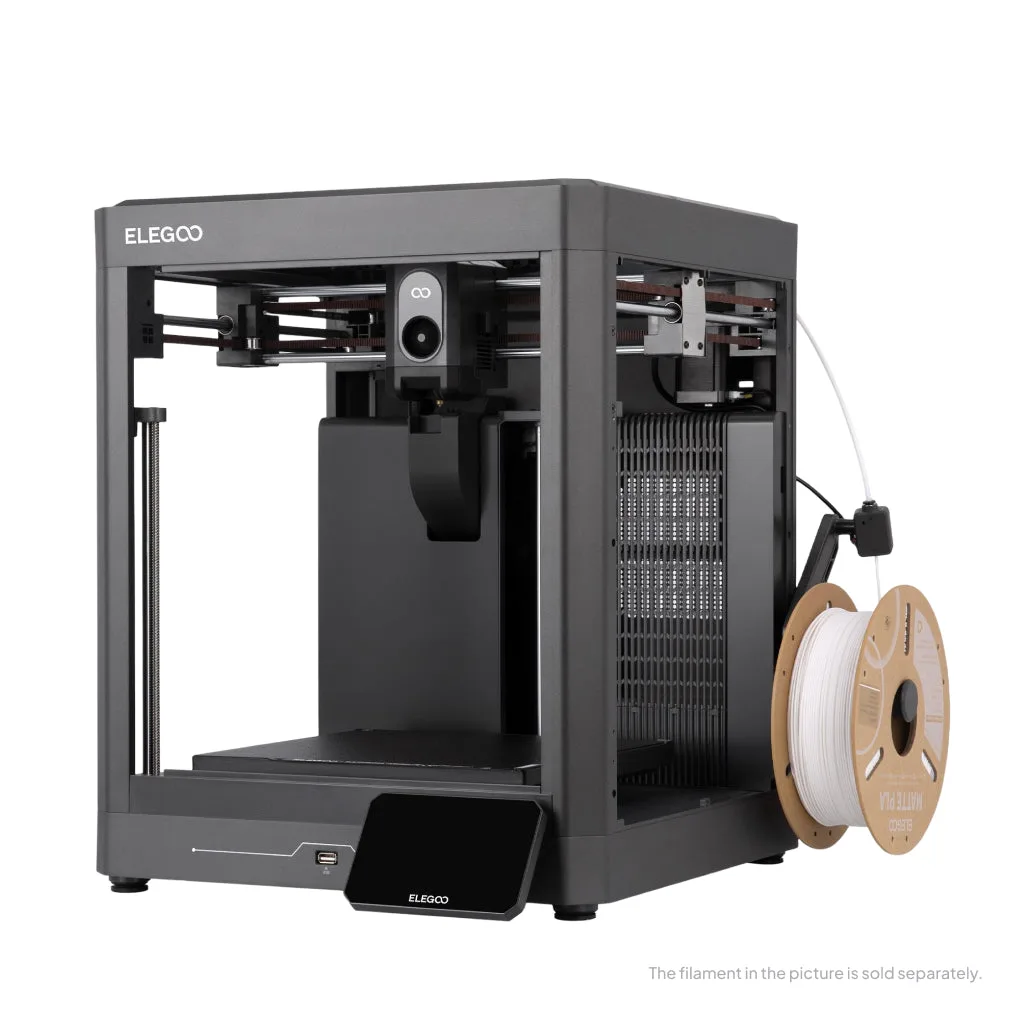
    ELEGOO Centauri 2 3D printer, official product image from ELEGOO
    Image: ELEGOO

    The newest model in this group, at $244 on the day we checked, marked down from $299 on the store page. ELEGOO lists a 256 mm cube, CoreXY motion, 500 mm/s speed, 20,000 mm/s² acceleration, a 350 °C nozzle and a die-cast aluminum frame. The page notes that its CANVAS multicolor add-on is sold separately, and a Combo version was listed on the store at $284, with $379 crossed out.

    Anycubic Kobra 4
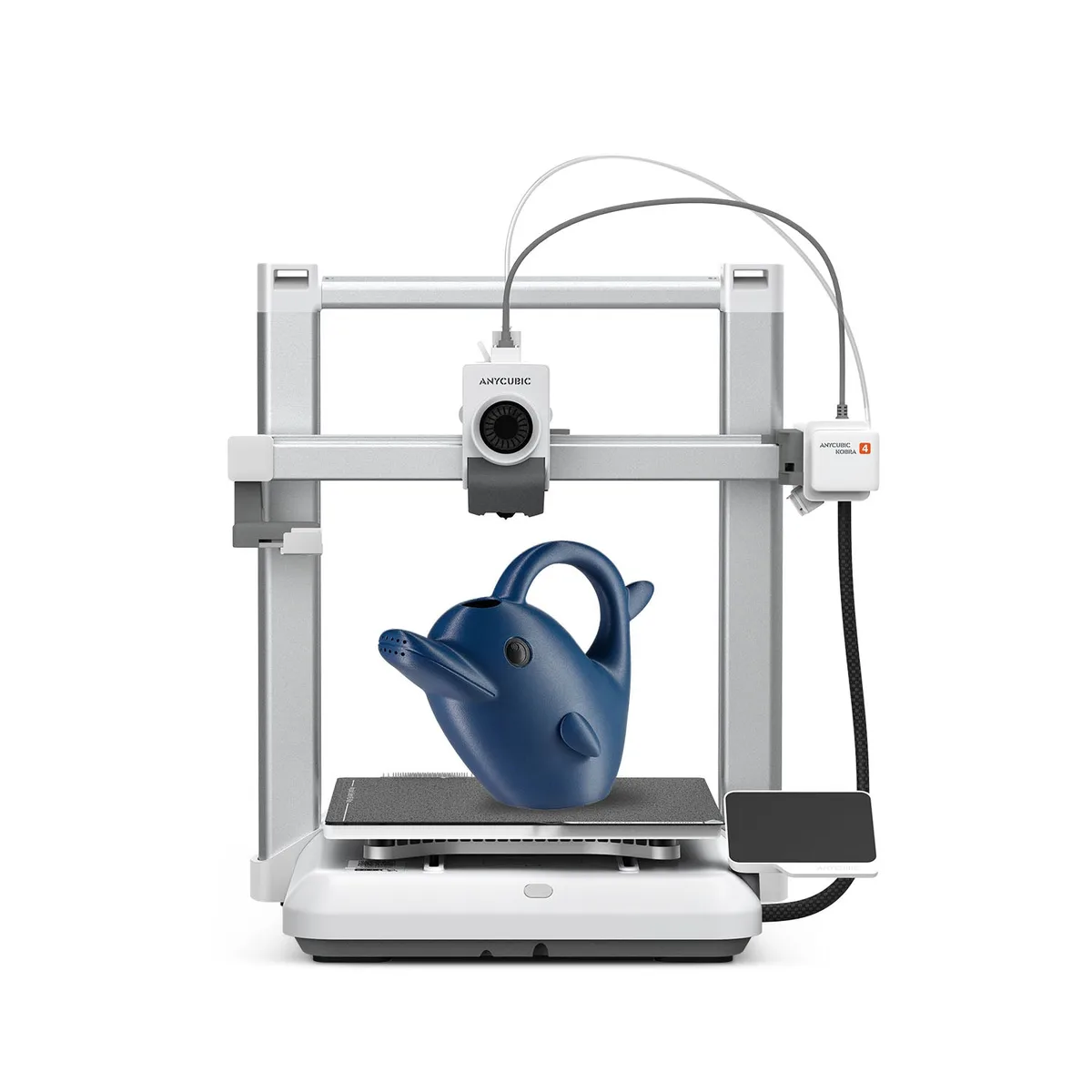
    Anycubic Kobra 4 3D printer, official product image from Anycubic
    Image: Anycubic

    Anycubic lists a 260 mm cube, 600 mm/s maximum speed (300 mm/s default), 20,000 mm/s² maximum acceleration, a hardened steel 0.4 mm nozzle rated to 300 °C and a 100 °C bed. It also lists LeviQ 3.0 auto-leveling, a 720P camera and noise at or below 48 dB in standard mode. Multi-color printing requires the separate ACE 2 Pro, which is why a Combo exists (the Kobra 4 Combo with four filament colors was listed at $379 on the store page).

    How to choose, using only the specs

    • Most build space for the price: the Kobra 4, Centauri 2 and Neptune 4 all land in a similar range per liter.
    • Smallest footprint and Bambu’s ecosystem: the A1 mini.
    • Lowest ticket price: the Ender-3 V3 SE at $169, then the A1 mini at $199.
    • Highest nozzle ceiling: the Centauri 2 at 350 °C, versus 300 °C for the rest where listed.

    Remember that top speeds are marketing numbers. Several of these brands themselves recommend lower speeds for everyday printing. And none of this tells you how reliable a machine is after six months, how good the slicer feels or how good support is. Those matter, and we cannot speak to them without testing.

    Also on Amazon

    These Amazon.com listings are sold by each brand’s own official Amazon store. Amazon prices can differ from the brand sites, so check current price. These are Amazon affiliate links.

    We have not added Amazon links for the Bambu Lab A1 mini, ELEGOO Neptune 4 or Neptune 4 Pro, or the Kobra 4 printer alone, because we could not confirm a matching official-store listing.

    Sources and date checked

    All prices were re-checked against the official store pages on November 27, 2026, and the sale prices and crossed-out prices are as each store showed them. Since the November 17, 2026 check, the Ender-3 V3 SE is listed at $169 with $199 crossed out, and the Kobra 4 printer now shows $379 crossed out (the Combo remains listed at $379). Brand stores change prices frequently, so treat this as a snapshot and check the linked page for the current price.
  • Bambu Lab A1 vs A1 Mini

    Bambu Lab A1 vs A1 Mini

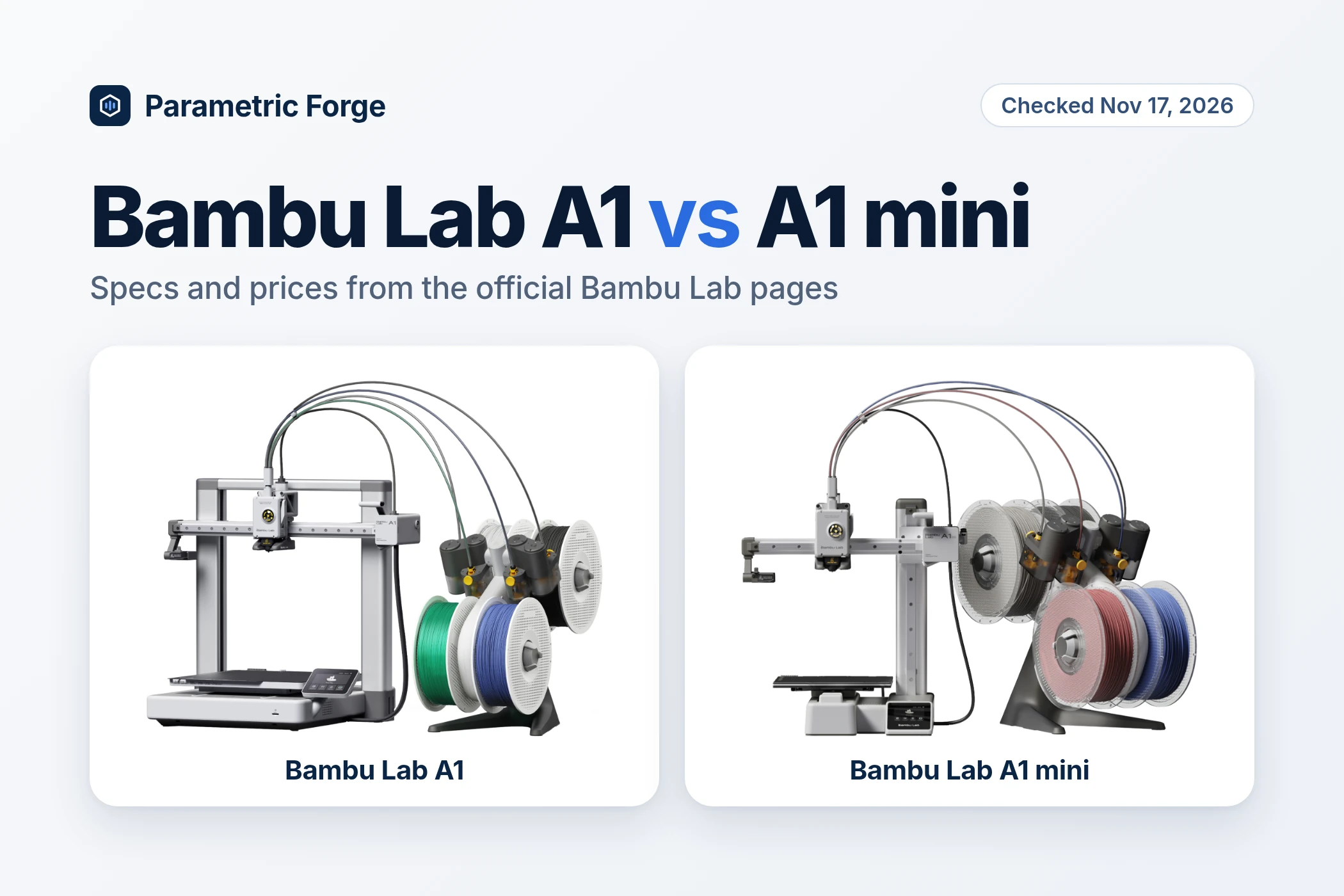
    Bambu Lab’s A1 and A1 mini are two versions of the same idea: a bed-slinger with automatic calibration, a direct-drive toolhead and an optional multi-color add-on. The big question for most buyers is whether the larger A1 is worth the extra money over the mini. This post compares the two using only what Bambu Lab publishes on its own store pages.

    How we compared: we have not printed on either machine. Every figure below was read from Bambu Lab’s official US store pages on November 17, 2026 (A1, A1 mini). Where a number is our own arithmetic, we label it as calculated. Prices change often, so check the store before you buy.

    Specs side by side

    Bambu Lab A1 3D printer, official product image from Bambu Lab
    Image: Bambu Lab
    Bambu Lab A1 mini 3D printer, official product image from Bambu Lab
    Image: Bambu Lab
    SpecBambu Lab A1Bambu Lab A1 mini
    Build volume (W x D x H)256 x 256 x 256 mm180 x 180 x 180 mm
    Hot endAll-metal, stainless steel nozzleAll-metal, stainless steel nozzle
    Max hot end temperature300 °C300 °C
    Nozzle size0.4 mm included; 0.2, 0.6, 0.8 mm available0.4 mm included; 0.2, 0.6, 0.8 mm available
    Max build plate temperature100 °C80 °C
    Max tool head speed500 mm/s500 mm/s
    Max tool head acceleration10,000 mm/s²10,000 mm/s²
    Included plateTextured PEITextured PEI
    Optional platesSmooth PEI, Dual-Texture PEI, High Temperature (Smooth PEI), Cool PlateSmooth PEI
    Filament listed as supportedPLA, PETG, TPU, PVAPLA, PETG, TPU, PVA
    Listed as not recommendedABS, ASA, PC, PA, PET, carbon or glass fiber reinforcedABS, ASA, PC, PA, PET, carbon or glass fiber reinforced
    Printer size465 x 410 x 430 mm347 x 315 x 365 mm
    Net weight8.3 kg5.5 kg
    Advertised noise level49 dB49 dB
    Store price for the printer alone, Nov 17, 2026$259$199 (page shows $219 as the typical price)
    Source: Bambu Lab US store product pages for the A1 and A1 mini, checked November 17, 2026. Prices were read during the store’s Black Friday sale banner and may change.

    The price row is for the printer on its own. Both pages also sell a Combo version that adds Bambu’s AMS lite multi-color unit. On our check date the A1 Combo was listed at $359 and the A1 mini Combo at $299.

    Where the two are identical

    The overlap is bigger than you might expect. Bambu lists the same top tool head speed (500 mm/s), the same acceleration (10,000 mm/s²), the same 300 °C hot end limit and the same nozzle options for both. Both pages also list the same sensor suite: filament run-out, filament odometry, power loss recovery and a filament tangle sensor. Both include a low frame rate camera with timelapse support, and both ship with a textured PEI plate.

    In practice, that means the choice is not about raw motion specs on paper. Bambu is selling the same motion platform at two sizes.

    Where they differ

    Build volume

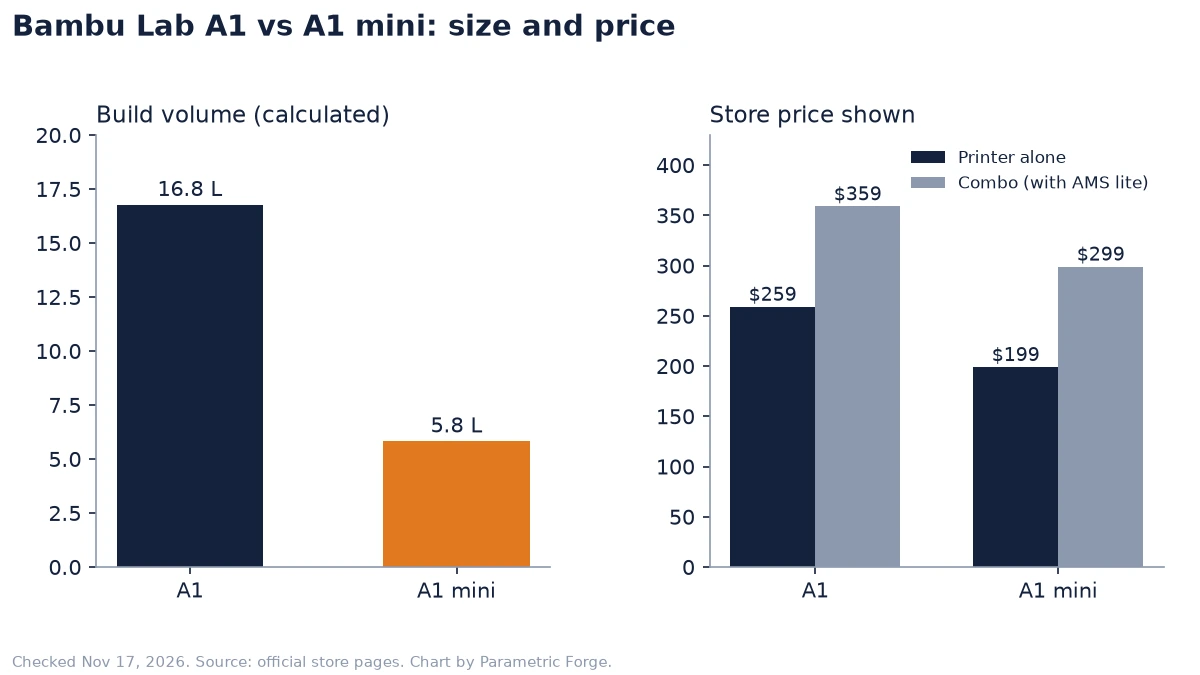
    The A1 offers 256 mm on every axis. The mini offers 180 mm. Converted to volume, that is about 16.8 liters versus 5.8 liters. That is our own calculation from Bambu’s listed dimensions (256 x 256 x 256 = 16,777,216 mm³ and 180 x 180 x 180 = 5,832,000 mm³), but the ratio is large: the A1’s build space is roughly 2.9 times the mini’s. If you print helmets, enclosures, tool holders or anything tall, the mini will force you to split parts. If you mostly print small brackets, figurines or desk accessories, 180 mm goes further than it sounds.

    Bed temperature

    The A1’s plate tops out at 100 °C and the mini’s at 80 °C. Bambu lists PLA, PETG, TPU and PVA as supported on both, so this difference may not matter for those materials. It is still a spec gap worth knowing about if you like to run PETG on a hotter bed.

    Size and weight

    The mini is listed at 5.5 kg and 347 x 315 x 365 mm. The A1 is listed at 8.3 kg and 465 x 410 x 430 mm. If your desk or shelf is tight, the mini’s footprint is a real advantage. The A1 needs noticeably more room, especially around its moving bed.

    Plate options

    The A1 page lists five plate types (Textured PEI included, plus Smooth PEI, Dual-Texture PEI, High Temperature and Cool Plate). The mini’s page lists two. If you want to experiment with different surface finishes, the A1 has more official choices.

    Price

    On our check date, the A1 on its own was listed at $259 and the mini at $199, a gap of $60. Using the build volume numbers above, the A1 works out to roughly $15 per liter of build space and the mini to roughly $34 per liter (calculated by us from list price and volume, rounded). The bigger machine is the better deal per unit of space, though the mini is the lower entry price.

    Charts comparing build volume and store price of the Bambu Lab A1 and A1 mini, checked November 17, 2026
    Chart: Parametric Forge. Prices checked November 17, 2026 from official store pages.

    Who each one suits, based on the specs

    • Choose the A1 if you want room to grow, print larger parts, or want the hotter 100 °C bed and the wider choice of plates.
    • Choose the A1 mini if you have limited space, print small items, or want the lowest entry price in Bambu’s lineup of these two models.

    Neither printer is listed as suited to ABS, ASA, nylon or carbon fiber filaments, since Bambu marks those as not recommended. If you want those materials, you would need to look at an enclosed printer instead. We cover that kind of comparison separately.

    What we cannot tell you

    Spec sheets do not show print quality, reliability over time or how loud a machine sounds in your room. We have not tested either printer, and we are not going to guess. For that kind of information, read owner reports and the brand’s own support pages. Bambu also notes on its A1 page that units sold after January 30, 2024 are not from the batch involved in an earlier heatbed cable recall, which is worth reading about on the store page if you are shopping.

    Where to buy

    We link to the official pages so you can confirm current pricing and bundles: Bambu Lab A1 and Bambu Lab A1 mini.

    The brand also runs official stores on Amazon.com. These listings are sold by Bambu Lab’s own Amazon store, and the price can differ from the official site, so check current price: Bambu Lab A1 (printer alone) and Bambu Lab A1 mini Combo. Both are Amazon affiliate links. We have not linked the other variants because we could not confirm an official-store listing for each.

    Prices were re-checked against both official store pages on November 17, 2026. The re-check matched our first read earlier the same day: A1 $259 (store shows $299 crossed out), A1 Combo $359, A1 mini $199 (store shows $219 crossed out) and A1 mini Combo $299. Specs were read from the same pages. We will refresh this post when Bambu Lab updates its pages.