Author: Parametric Forge

  • Maker Tools That Pair Well With a 3D Printer

    Maker Tools That Pair Well With a 3D Printer

    Read this first: four of the five tools below are, or recently were, Kickstarter campaigns. A pledge is support for a project that may not have shipped yet. Goals, specifications, prices and delivery dates can change, and some campaigns deliver late or never. Only pledge money you can afford to lose, and read each campaign page and its FAQ before you back anything. The fifth item, the KER Tools store, is a regular store listing, not a live campaign.

    Disclosure: the campaign and store links in this post are referral links through Kickbooster. If you back a campaign or buy through one, we may earn a commission, at no extra cost to you. We are not affiliated with these creators, we have not hands-on tested any of these products, and this is a research roundup built from published campaign and brand materials. See our affiliate disclosure.

    A 3D printer is only part of a workshop. Some people want to copy a physical part, cut metal or plastic that a printer cannot, measure a fit, paint a model, or open a case without emptying a toolbox. This guide looks at five tools that sit next to a printer, using official brand pages and public campaign trackers, with every funding figure dated. Campaigns end, so treat the Kickstarter links as temporary. When a campaign closes we will remove or update those links. The KER Tools store link is meant to stay.

    Snapshot

    ToolWhat it isStatus, as of November 23, 2026Price shownDelivery or shipping, as stated
    Revopoint MIRACO 2Standalone 3D scannerLive Kickstarter (launched Nov 18, 2026). End date not confirmed on Revopoint’s own launch post.Super Early Bird from $1,425, up to 38% off, per RevopointNot stated on the Revopoint launch post we read
    Rownd 5XDesktop 5-axis CNC millLive Kickstarter. Campaign listings have given a close date of Dec 11, 2026; confirm on the campaign page.Campaign listings have shown $5,999 for a Super Early Bird base model and $7,999 for the Pro with a tool changer. Confirm current tiers.Rownd’s site says production shipments are planned to begin in Q2 2027
    RODMAN 9-in-1 caliperTitanium pocket caliper and multi-toolLive Kickstarter. Campaign listings have given dates of Nov 12 to Dec 12, 2026; confirm on the campaign page.Not confirmed from an official source we could readNot confirmed from an official source we could read
    LionBow sprayer240 g cordless precision sprayerLive Kickstarter. Campaign listings have given dates of Nov 12 to Dec 12, 2026; confirm on the campaign page.Not confirmed from an official source we could readNot confirmed from an official source we could read
    KER Tools CubeFIX55-in-1 folding tool cubeRegular store listing (the CubeFIX Kickstarter already ended in April 2026)$40, with $51 crossed out, on the official store page checked November 23, 2026The product page showed “48hr Ship-out in US”. Confirm shipping at checkout.
    Snapshot compiled November 23, 2026. Kickstarter end dates and some prices come from public campaign listings and should be confirmed on each campaign page. Tracker funding figures, where used below, can lag the live campaign.

    Revopoint MIRACO 2: a scanner that can work without a PC

    Revopoint describes the MIRACO 2 as a standalone 3D scanner: depth computation, scanning, point cloud processing and basic editing sit in one 960 g handheld unit, with a 6-inch 2K AMOLED touchscreen. Its November 18, 2026 launch post lists an 8-core CPU and a 6-core NPU, and three ways to work: on the device, over Wi-Fi 6, or over USB-C 3.0 to a PC. In Multi-Line Laser mode on a GPU-powered PC, Revopoint quotes speeds of up to 120 frames per second.

    The same post lists six scanning modes, including 34-line blue cross laser, 15-line parallel laser, a single-line deep-hole laser, Full-Field HD, VCSEL Rapid and Hybrid HD. Revopoint quotes single-frame accuracy of up to 0.02 mm in Multi-Line Laser mode, and a capture rate of up to 10 million points per second in Hybrid HD. It recommends a minimum object size of 10 x 10 x 10 mm, and a maximum volume of 5 x 5 x 5 m with the optional Photogrammetric Metrology Kit. Markerless tracking for textured objects in the laser-line modes is listed as a PC-mode feature. Two memory configurations are listed: 16 GB RAM with 256 GB storage, or 32 GB RAM with 512 GB storage. Runtime is given as about three hours from a 10,000 mAh battery, with 65 W fast charging, and ambient light support up to 100,000 lux.

    Revopoint also pitches Revo Agents, software that, in its words, helps turn scans into CAD models or inspection results from natural-language prompts. That is the company’s claim, not a test of ours. We have not hands-on tested the scanner. The Super Early Bird pledge is listed at $1,425, described as up to 38% off. We could not confirm the campaign end date or a ship date on that launch post, so check the live campaign page for both.

    Rownd 5X: five-axis milling on a desk

    Rownd Precision’s own Rownd 5X page describes a fully enclosed desktop CNC mill that can run simultaneous 5-axis, 3+2 indexed and 3-axis work. In 3-axis mode the listed working area is 265 x 240 x 180 mm. In 5-axis mode the listed capacity is a 200 mm diameter by 180 mm cylinder, and Rownd notes that a rectangular part has to fit inside that envelope. The spindle is listed as 2.2 kW, water cooled, at 24,000 rpm, with a 10-tool ISO20 automatic tool changer on the equipped package, a 13.3-inch touchscreen, and positioning repeatability of ±0.02 mm. The page says specifications are subject to change as development continues.

    The same site says the machine runs on standard 220 V or 110 V outlets, with no industrial 3-phase power required, and that production shipments are planned to begin in Q2 2027 after the Kickstarter campaign. Public campaign listings have shown a Super Early Bird base price of $5,999 and a Pro price of $7,999 with the tool changer, and a close date of December 11, 2026. Confirm both on the campaign page. A BackerKit tracker snapshot on November 23, 2026 showed $927,900 pledged toward a $35,000 goal, from 128 backers, in US dollars as the tracker reported them. A mill in this class also needs space, power and, according to campaign materials reported elsewhere, compressed air. Read the campaign FAQ for those requirements before you pledge.

    RODMAN 9-in-1 caliper: a pocket measuring tool

    The 9-in-1 Multifunctional Caliper is a Kickstarter project from RODMAN. Campaign materials describe a Grade 5 titanium pocket tool with dual measurement scales, three measurement modes, a built-in blade, a screwdriver, a pry bar, a bottle opener, a nail puller and laser-engraved markings. That is a compact everyday-carry design, not a substitute for a full-size digital caliper used for close printer or CNC setup work. If you need verified accuracy or a long measuring range, look at a dedicated caliper and treat this as a pocket tool until the creator publishes a clear accuracy spec.

    Campaign listings have given a run of November 12 to December 12, 2026. A BackerKit tracker snapshot on November 23, 2026 showed $16,414 pledged toward a $1,100 goal, from 249 backers. We did not confirm pledge prices or a delivery date from an official page we could read, so check the campaign for both. The built-in blade may also make the tool a poor fit for some workplaces or for air travel. View the caliper campaign (referral link).

    LionBow: a cordless sprayer for models and touch-ups

    LionBow is a 240 g cordless precision sprayer from Premiumcraft, aimed at models, crafts and furniture touch-ups. Campaign materials list a 0.3 mm nozzle for finer work and a 0.5 mm nozzle for wider coverage, four pressure levels, and two bottles, 24 ml and 50 ml. They also describe a marker-compatible mode, so a compatible marker can be sprayed through the tool or faded through a stencil. A built-in 1,100 mAh battery is part of the listing. For painted prints, this sits in the same finishing conversation as the Makvona ModelPop markers in our earlier crowdfunding roundup, though the two tools are not interchangeable.

    Campaign listings have given a run of November 12 to December 12, 2026. We did not confirm pledge prices, a ship date, or a current funding total from an official page we could read. Check the campaign page for those figures, and for which marker sizes it actually accepts, before you pledge.

    KER Tools CubeFIX: a store toolkit, not a campaign

    Unlike the four items above, KER Tools CubeFIX is sold on the company’s own store. Its Kickstarter campaign ended in April 2026. On November 23, 2026 the official product page listed the 55-in-1 tool cube at $40, with $51 crossed out, in stock, with a line reading “48hr Ship-out in US” and a 30-day money-back guarantee. The store’s packing list includes 36 precision bits, 6 open-end wrenches, 5 stainless pry tools, 6 triangle pry tools, a handle that switches between straight and L-shape modes, the folding cube and a manual. The page also showed a “limited-time: Free shipping” line, while the shipping policy says free shipping applies to orders over $75, so confirm the shipping total at checkout.

    KER has a maker-facing article that is more careful than the marketing copy. It says CubeFIX can help with compatible, documented cover and low-load fastener work on a desktop 3D printer after the machine is shut down, unplugged and cool. It is not, in KER’s own words, a complete printer-maintenance or calibration kit, and it is not for mains wiring, power supplies, hot ends or energized diagnostics. That matches how we would place it: a compact precision kit for small screws and covers, not a substitute for the tools a printer manual calls out.

    How these sit next to a printer

    • Want to copy a physical part and print it: a scanner is the relevant tool. MIRACO 2 is one option on Kickstarter, at a much higher price than any printer in our buying guide.
    • Want geometry or materials a filament printer cannot make: a mill such as the Rownd 5X is a different class of machine, with power, space and safety needs of its own.
    • Want to measure a fit: a dedicated caliper is the usual answer. The RODMAN tool adds pocket functions, at the cost of being a compact multi-tool.
    • Want to paint a print: a sprayer such as LionBow, or paint markers, is a finishing step, not a substitute for choosing filament. See our filament guide for the material side.
    • Want a small kit for covers and screws: CubeFIX is the one item here you can buy from a store today, with a return policy on the seller’s page.

    Campaigns end. Plan for that.

    Kickstarter links in this post will go stale when the campaigns close, some as soon as mid-December 2026 if the listed dates hold. We will update or remove those links after the campaigns end. A pledge is not a store order. If a campaign is still live, you can usually change or cancel a pledge before it ends, subject to Kickstarter’s rules. After it ends, refund terms are set by the creator. The KER Tools store link is the exception: it points at a live product page and is meant to remain.

    For other live 3D printing campaigns we have already written about, see our Crowdfunding Watch draft when it is published. For printers you can buy now, start with the best printers under $300 post. And read how we research for how we handle specs and dated prices.

    Sources, checked November 23, 2026: Revopoint’s MIRACO 2 launch post on revopoint3d.com (Nov 18, 2026); Rownd Precision’s Rownd 5X page; the KER Tools CubeFIX product page and its maker blog post; public campaign listings and BackerKit trackers for campaign dates and funding snapshots. Confirm every live figure on the creator’s campaign or store page.
  • Black Friday 3D printer deals 2026: official store prices

    Black Friday 3D printer deals 2026: official store prices

    This page lists 3D printer prices that official brand stores showed on November 27, 2026, with the store’s own crossed-out price where it showed one. We have not hands-on tested any of these printers. Every number below was read from the linked official store page on that date, and Black Friday prices can change or end without notice, so confirm on the store before you buy.

    Dates: Black Friday is November 27, 2026 and Cyber Monday is November 30, 2026. Brand stores have already started their sales. We plan to re-read these pages and update this post as the sales move.

    Prices read on November 27, 2026

    Brand Model Price shown Crossed-out price shown Difference (calculated) Notes Amazon
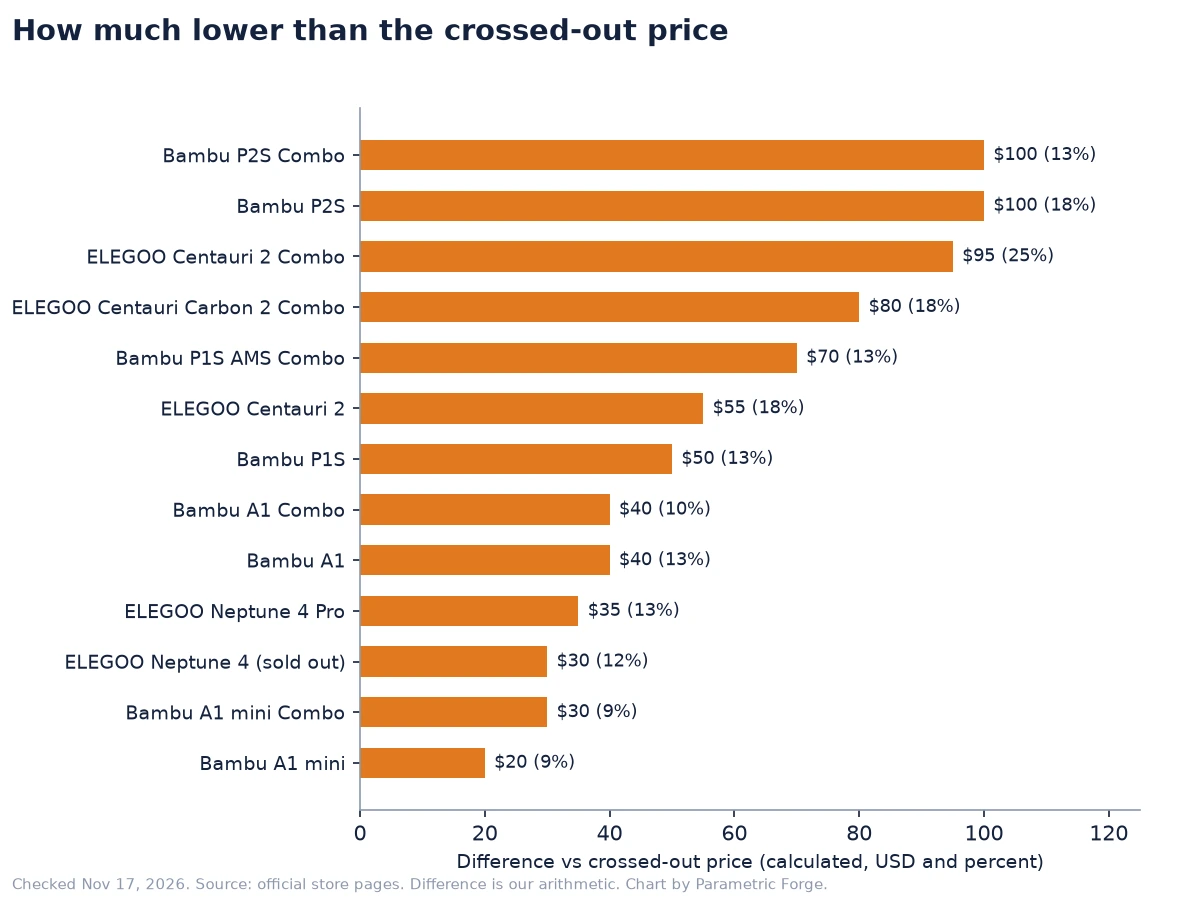
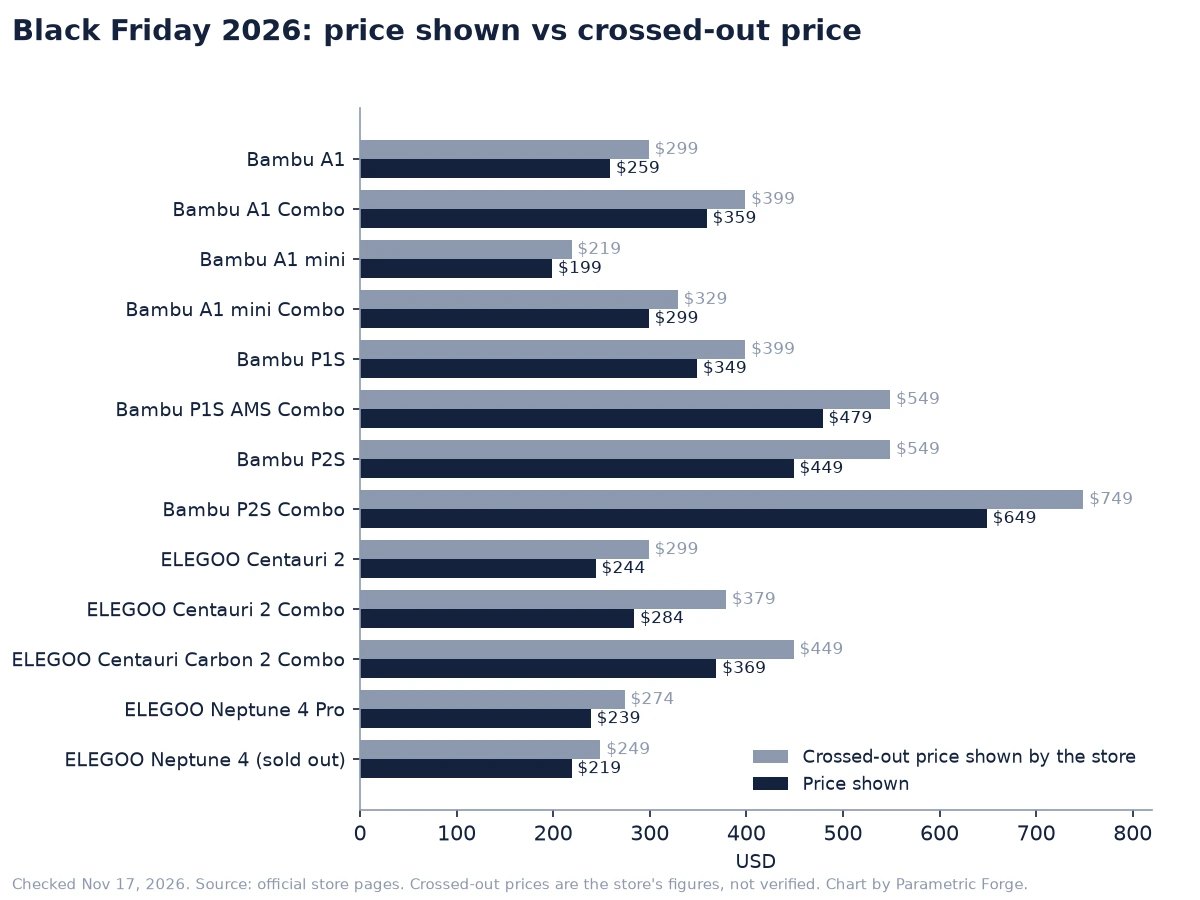
    Bambu Lab A1 (printer alone) $259 $299 $40 (13%) Check price
    Bambu Lab A1 Combo $359 $399 $40 (10%) Includes AMS lite Not linked
    Bambu Lab A1 mini (printer alone) $199 $219 $20 (9%) Not linked
    Bambu Lab A1 mini Combo $299 $329 $30 (9%) Includes AMS lite Check price
    Bambu Lab P1S (printer alone) $349 $399 $50 (13%) Check price
    Bambu Lab P1S AMS Combo $479 $549 $70 (13%) Check price
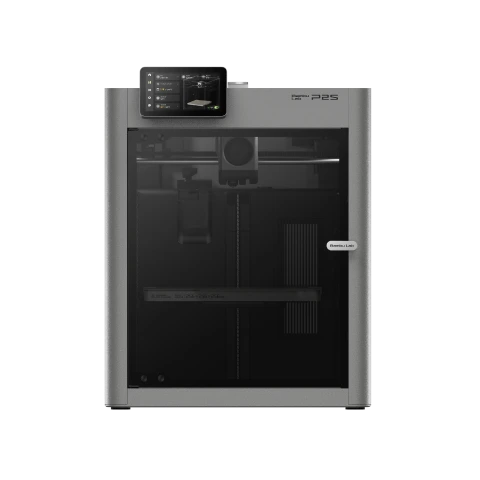
    Bambu Lab P2S (printer alone) $449 $549 $100 (18%) Check price
    Bambu Lab P2S Combo $649 $749 $100 (13%) Check price
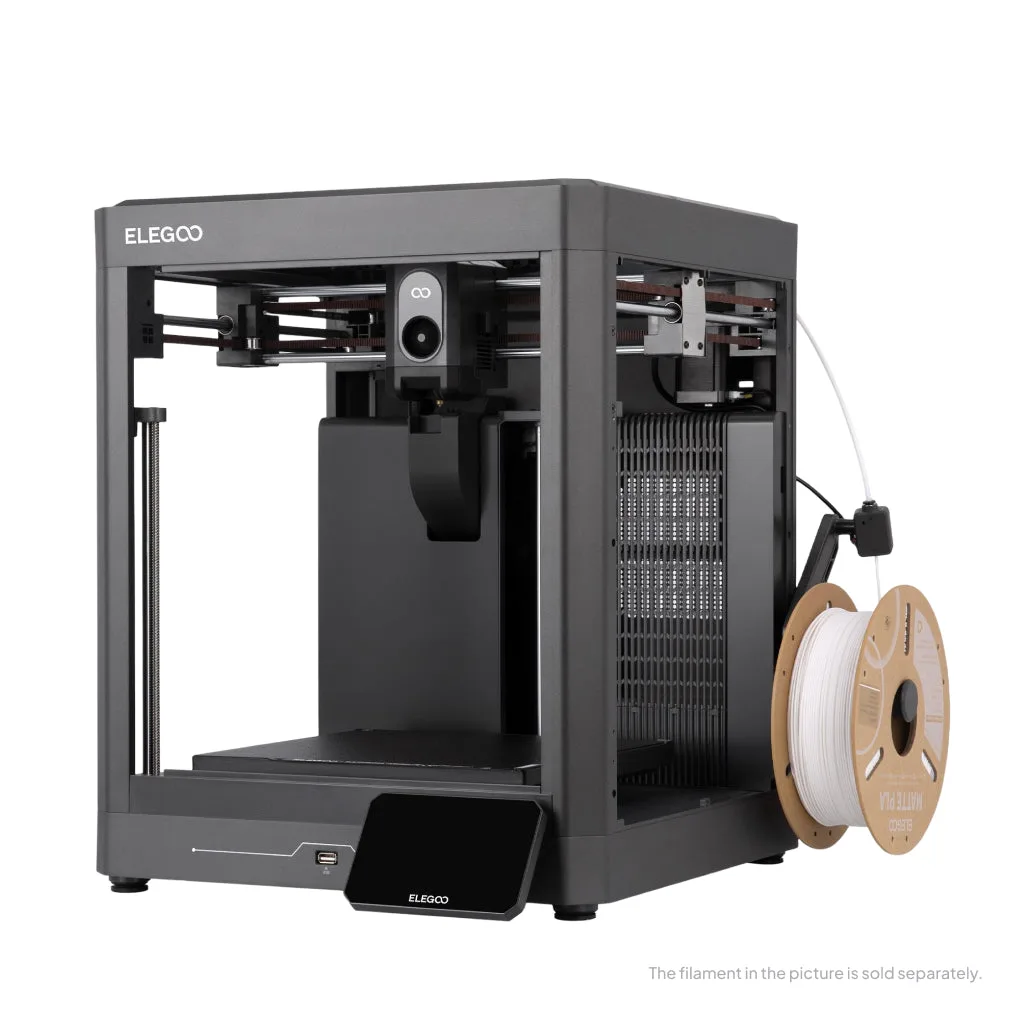
    ELEGOO Centauri 2 $244 $299 $55 (18%) Store page shows a sale countdown Check price
    ELEGOO Centauri 2 Combo $284 $379 $95 (25%) Combo price from the store’s product tile Check price
    ELEGOO Centauri Carbon 2 Combo $369 $449 $80 (18%) Check price
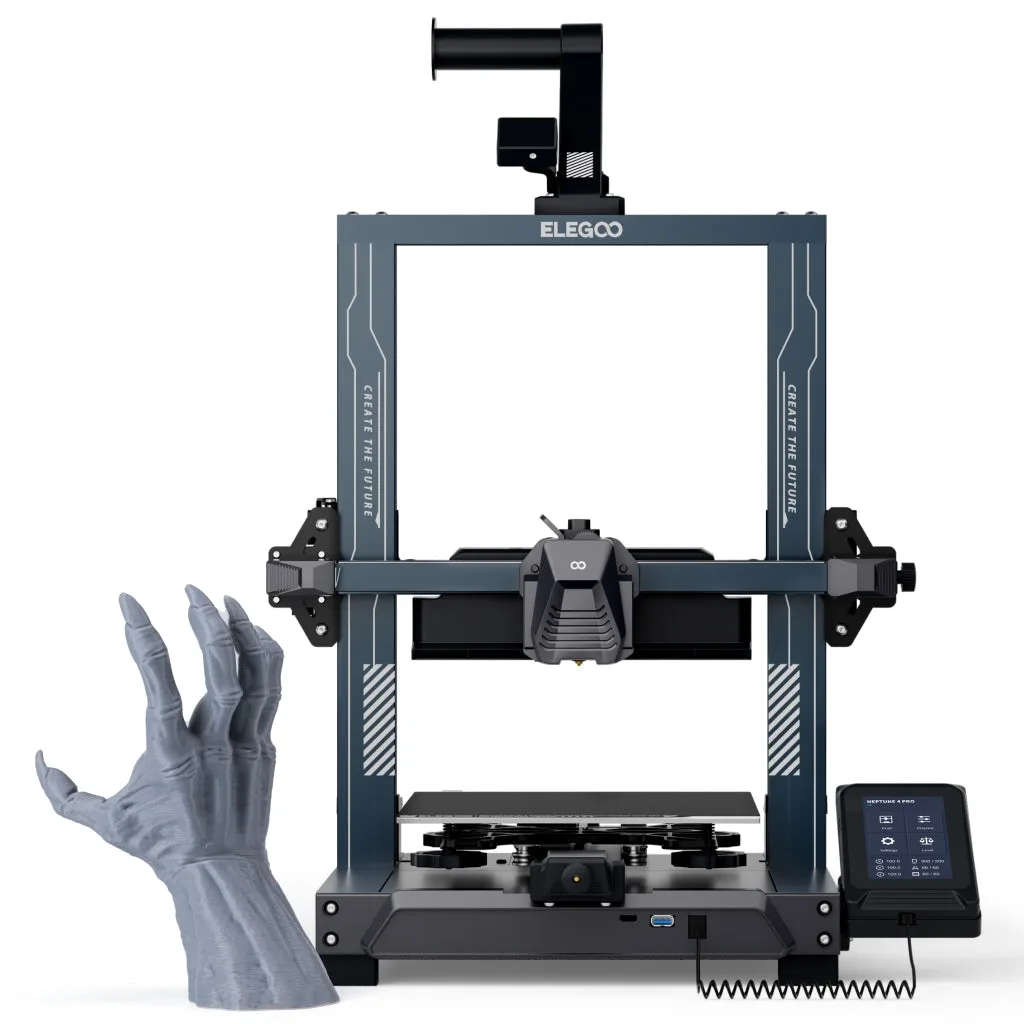
    ELEGOO Neptune 4 Pro (Type-C version) $239 $274 $35 (13%) Store lists only the Type-C version Not linked
    ELEGOO Neptune 4 $219 $249 $30 (12%) Sold out on all variants Not linked
    Source: official brand store product pages, read November 27, 2026. Crossed-out prices are as each store showed them. The difference is our own arithmetic against that crossed-out price and is rounded. Stores can change these at any time.
    Bar chart of price shown against crossed-out price for 13 printers on official stores, checked November 27, 2026
    Chart: Parametric Forge. Prices checked November 27, 2026 from official store pages. Crossed-out prices are the stores’ figures.
    Bar chart of the dollar difference between price shown and crossed-out price for 13 printers, checked November 27, 2026
    Chart: Parametric Forge. Differences are our own arithmetic from prices checked November 27, 2026 on official store pages.

    The models in the table

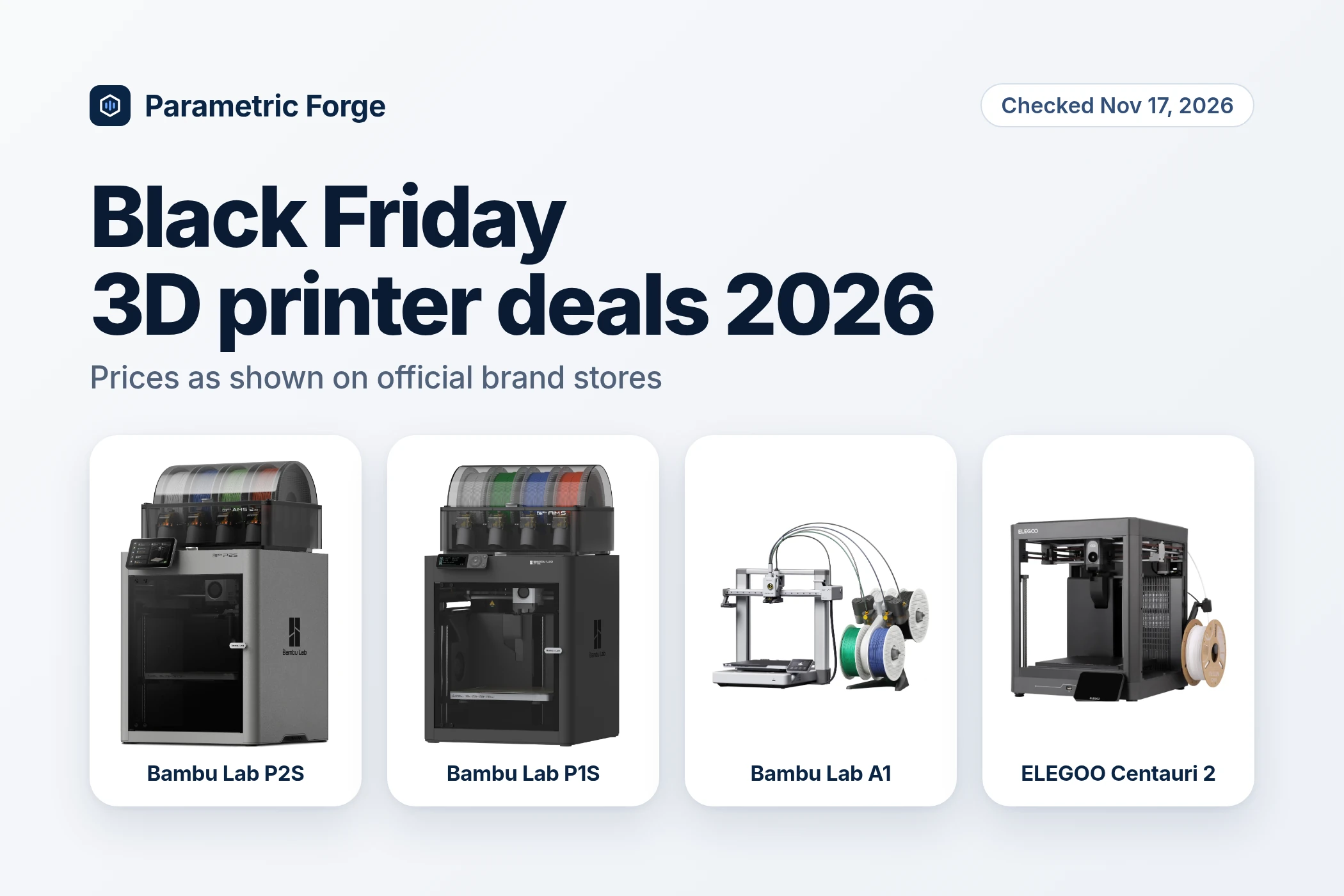
    Official product images from each brand. Combos add extra hardware, and the Combo prices above are not for the printer alone.

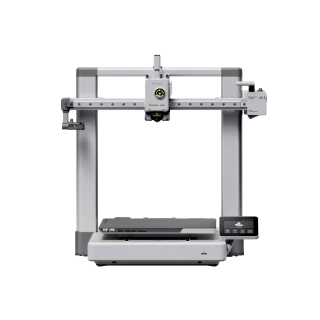
    Bambu Lab A1 3D printer, official product image from Bambu Lab
    Image: Bambu Lab
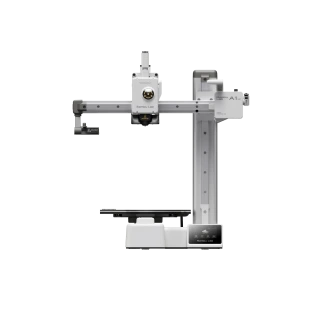
    Bambu Lab A1 mini 3D printer, official product image from Bambu Lab
    Image: Bambu Lab
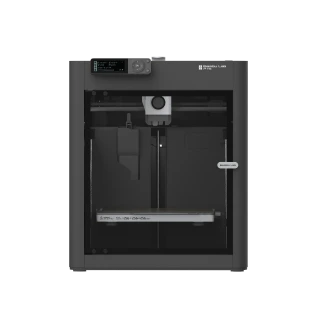
    Bambu Lab P1S 3D printer, official product image from Bambu Lab
    Image: Bambu Lab
    Bambu Lab P2S 3D printer, official product image from Bambu Lab
    Image: Bambu Lab
    ELEGOO Centauri 2 3D printer, official product image from ELEGOO
    Image: ELEGOO
    ELEGOO Neptune 4 Pro 3D printer, official product image from ELEGOO
    Image: ELEGOO

    Anycubic and Creality prices

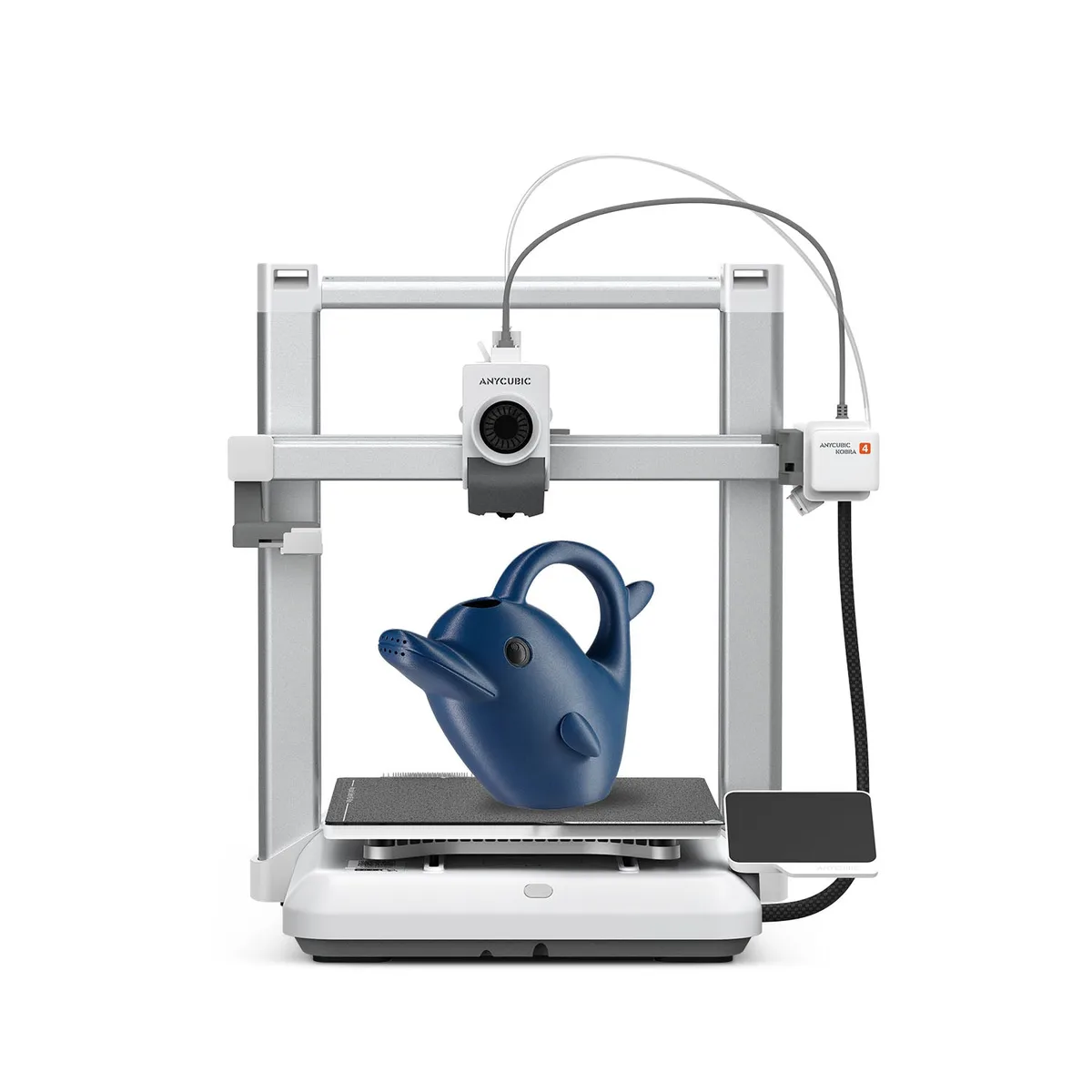
    • Anycubic Kobra 4: the store listed the printer at $279 and showed $379 as the crossed-out regular price. The Kobra 4 Combo with four filament colors was listed at $379. Amazon: Check price on Amazon (Kobra 4 Combo only).
    • Creality Ender-3 V3 SE: the store listed it at $169 and showed $199 as the crossed-out price. The page carried a Black Friday bundle banner, and the options list included a bundle with a laser engraver. We did not compare that bundle’s price. Amazon: Check price on Amazon (printer).
    Anycubic Kobra 4 3D printer, official product image from Anycubic
    Image: Anycubic
    Creality Ender-3 V3 SE 3D printer, official product image from Creality
    Image: Creality

    What the store pages say about the sales

    • Bambu Lab showed a banner reading “Black Friday Week” with sitewide 2x credits. The product description also mentions 30-day price protection, a 2-year warranty and 30-day returns at the official store. Read Bambu’s terms on the store before relying on any of that.
    • ELEGOO showed a banner reading “Black Friday & Cyber Monday Deals Are Live!”
    • The prices in this post are the official store prices read on the date shown. We did not record Amazon prices. The Amazon column links to listings sold by each brand’s own Amazon store (affiliate links), so check current price there. We did not check other retailers.

    How to read a sale price

    • Compare like with like. A Combo includes extra hardware (an AMS lite or similar), so its price is not comparable with the printer alone.
    • A crossed-out price is the store’s claim about a regular price. We repeat it as shown and do not verify it.
    • Check build volume, speed and supported filaments on the specs pages before buying on price alone. Our best printers under $300 and A1 vs A1 mini posts compare official specs.
    • Sold out items can return at a different price.

    Sources and date checked

    All prices read on November 27, 2026. See how we collect and date prices on our How we research page. Last updated November 27, 2026.

  • Best 3D Printers Under $300

    Best 3D Printers Under $300

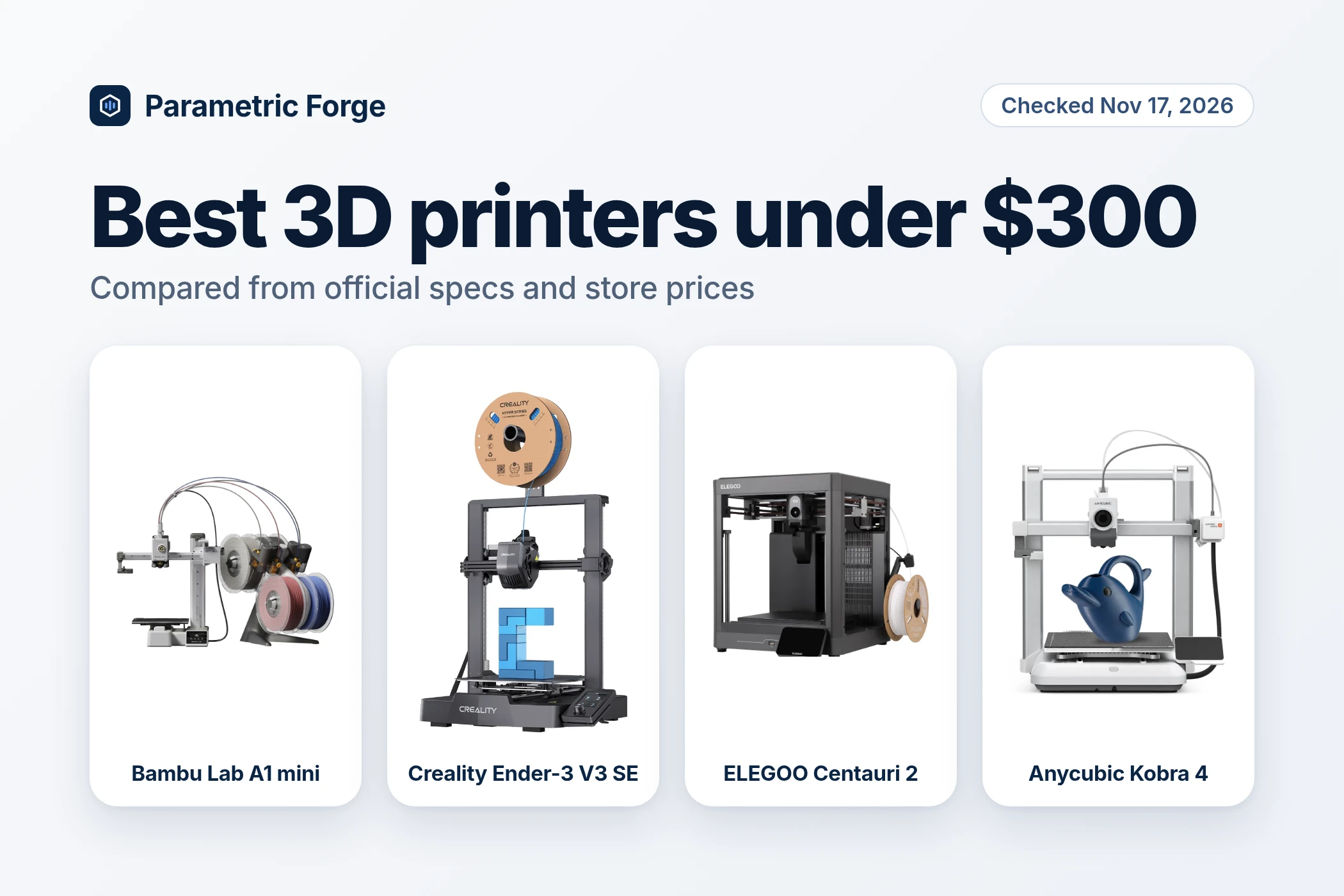
    Sub-$300 printers have changed a lot. Several brands now sell fast, auto-leveling machines for less than the price of a mid-range phone. This guide lines up six of them from Bambu Lab, Creality, ELEGOO and Anycubic using only the figures on each brand’s own store page.

    How we compared: we have not hands-on tested any of these printers. The table below was built from the official store pages linked in the sources list, read on November 27, 2026. We only included printers whose store page showed a price at or below $299 that day. Where a spec was not on the page we read, the table says so instead of filling in a guess. Sale prices come and go, especially around Black Friday, so confirm the price before you buy.

    The shortlist at a glance

    Printer Listed price, Nov 27, 2026 Build volume Max speed Max nozzle temp Max bed temp
    Bambu Lab A1 mini $199 (store shows $219 crossed out) 180 x 180 x 180 mm 500 mm/s 300 °C 80 °C
    Creality Ender-3 V3 SE $169 (store shows $199 crossed out) Not stated on page 250 mm/s Not stated on page Not stated on page
    ELEGOO Neptune 4 $219 (store shows $249 crossed out), listed as sold out on Nov 27 225 x 225 x 265 mm 500 mm/s 300 °C 110 °C
    ELEGOO Neptune 4 Pro $239 (store shows $274 crossed out) 225 x 225 x 265 mm 500 mm/s 300 °C Not read
    ELEGOO Centauri 2 $244 (store shows $299 crossed out) 256 x 256 x 256 mm 500 mm/s 350 °C Not read
    Anycubic Kobra 4 $279 (store shows $379 crossed out) 260 x 260 x 260 mm 600 mm/s 300 °C 100 °C
    Sources: official brand store pages listed below, checked November 27, 2026. Crossed-out prices are as shown by each store and are not our estimates. Max speed is the brand’s headline figure, not a recommended print speed.

    Build space for the money

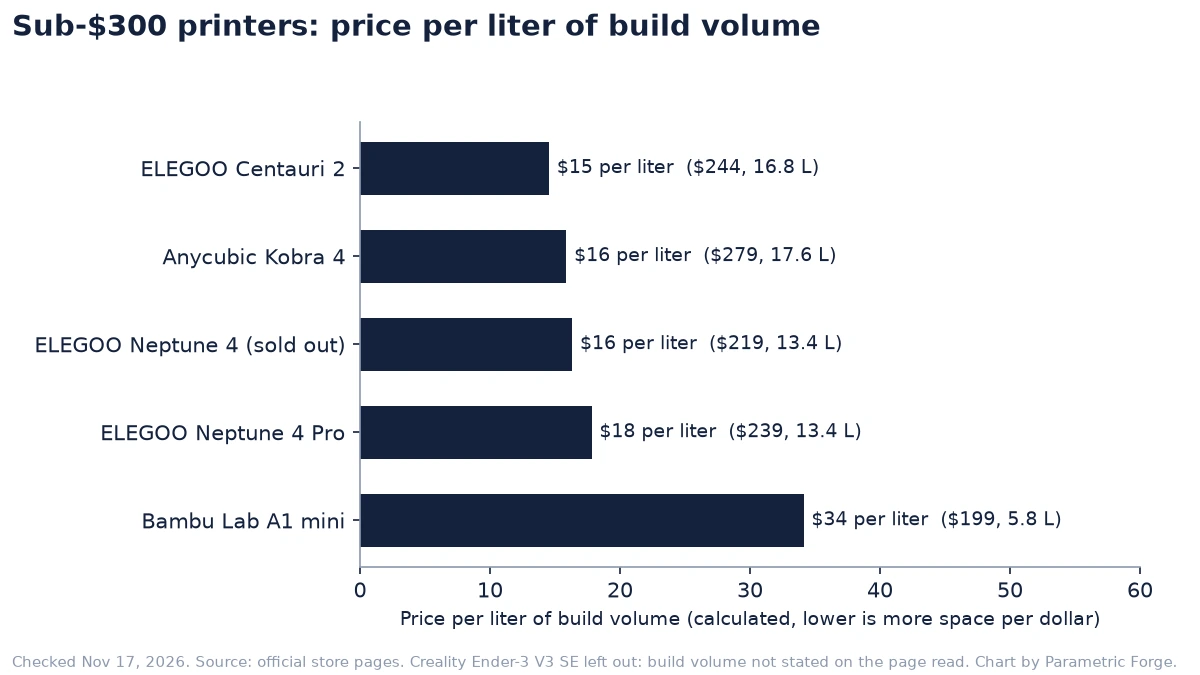
    A cheap printer with a tiny bed can be a worse deal than a slightly pricier one with more room. This table divides each printer’s listed price by its build volume. These numbers are calculated by us from the listed price and listed dimensions, rounded, and are estimates of value, not measurements of anything.

    Printer Build volume (calculated) Price per liter (calculated)
    Bambu Lab A1 mini 5.8 L $34
    Creality Ender-3 V3 SE Not stated n/a
    ELEGOO Neptune 4 13.4 L $16
    ELEGOO Neptune 4 Pro 13.4 L $18
    ELEGOO Centauri 2 16.8 L $15
    Anycubic Kobra 4 17.6 L $16
    Calculated by Parametric Forge from official list prices and build dimensions as of November 27, 2026.

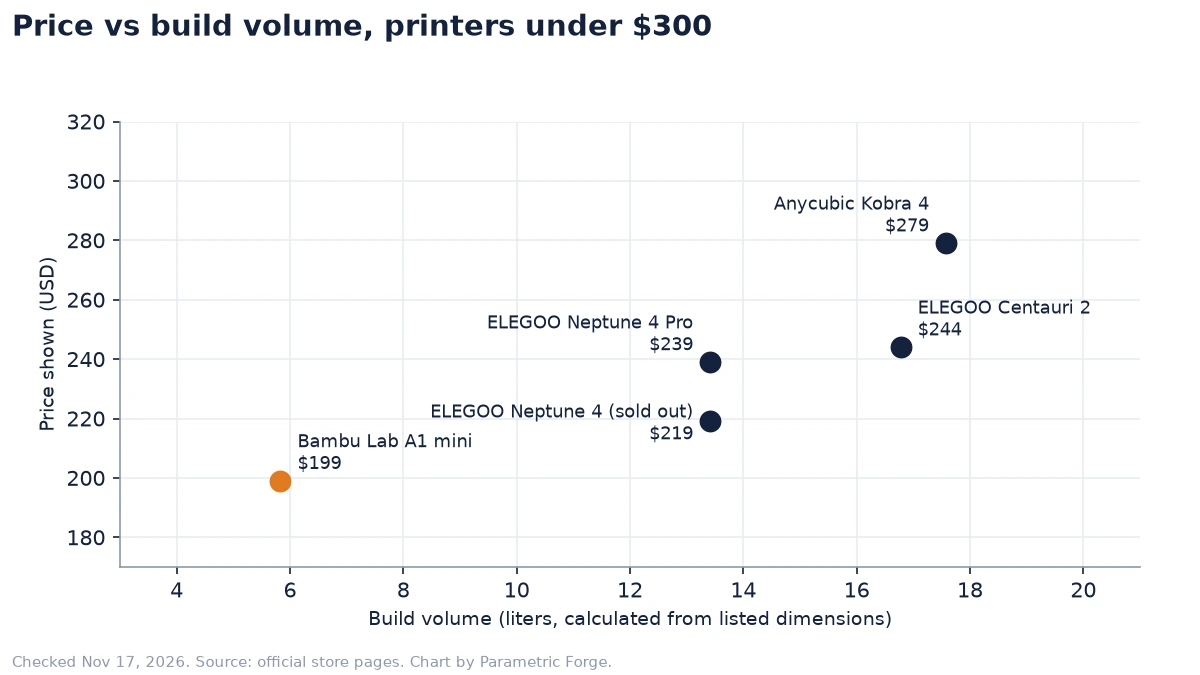
    Taking those numbers at face value, the ELEGOO and Anycubic machines offer the most build space per dollar here, and the A1 mini the least, which is what you would expect from its compact size.

    Bar chart of price per liter of build volume for five printers under $300, checked November 27, 2026
    Chart: Parametric Forge. Prices checked November 27, 2026 from official store pages.
    Scatter chart of price against build volume for five printers under $300, checked November 27, 2026
    Chart: Parametric Forge. Prices checked November 27, 2026 from official store pages.

    What stands out on paper

    Bambu Lab A1 mini

    Bambu Lab A1 mini 3D printer, official product image from Bambu Lab
    Image: Bambu Lab

    The smallest and most compact option, with a 180 mm cube, a 300 °C hot end and an 80 °C bed. Bambu’s page lists PLA, PETG, TPU and PVA as supported and advertises a 49 dB noise level. It is the entry ticket into Bambu’s ecosystem and pairs with an optional AMS lite for multi-color, but you give up space. Our A1 versus A1 mini comparison covers it in depth.

    Creality Ender-3 V3 SE

    Creality Ender-3 V3 SE 3D printer, official product image from Creality
    Image: Creality

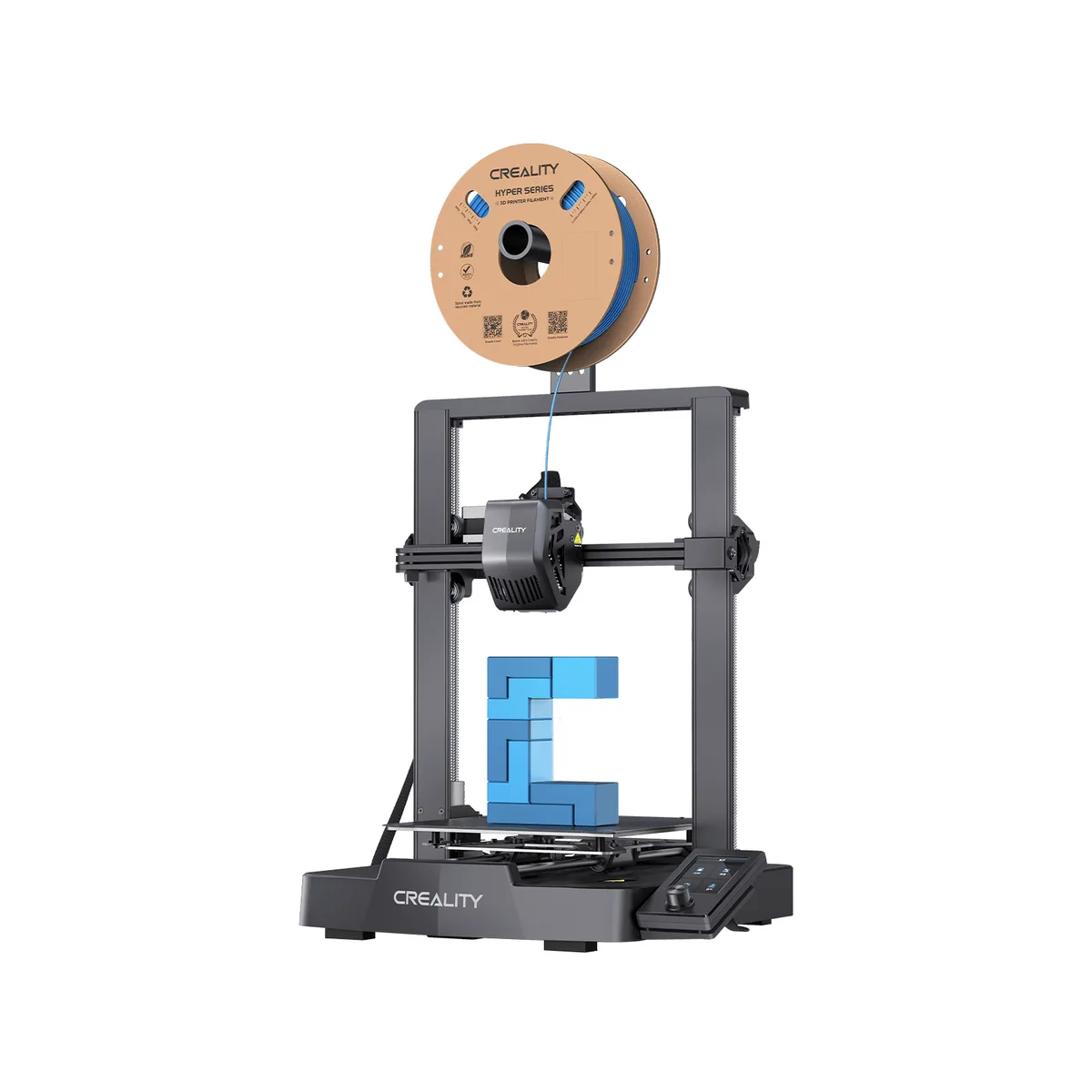
    At $169 it is the cheapest printer in this group. The store page we read lists a 250 mm/s maximum speed, 2,500 mm/s² acceleration, a CR Touch sensor with strain sensors for leveling, a Sprite direct extruder for PLA, PETG and TPU, and dual Z-axis rods. It did not list build volume or temperature limits in the text we could read, so we left those blank rather than rely on memory. Check Creality’s page for the full sheet.

    ELEGOO Neptune 4 and Neptune 4 Pro

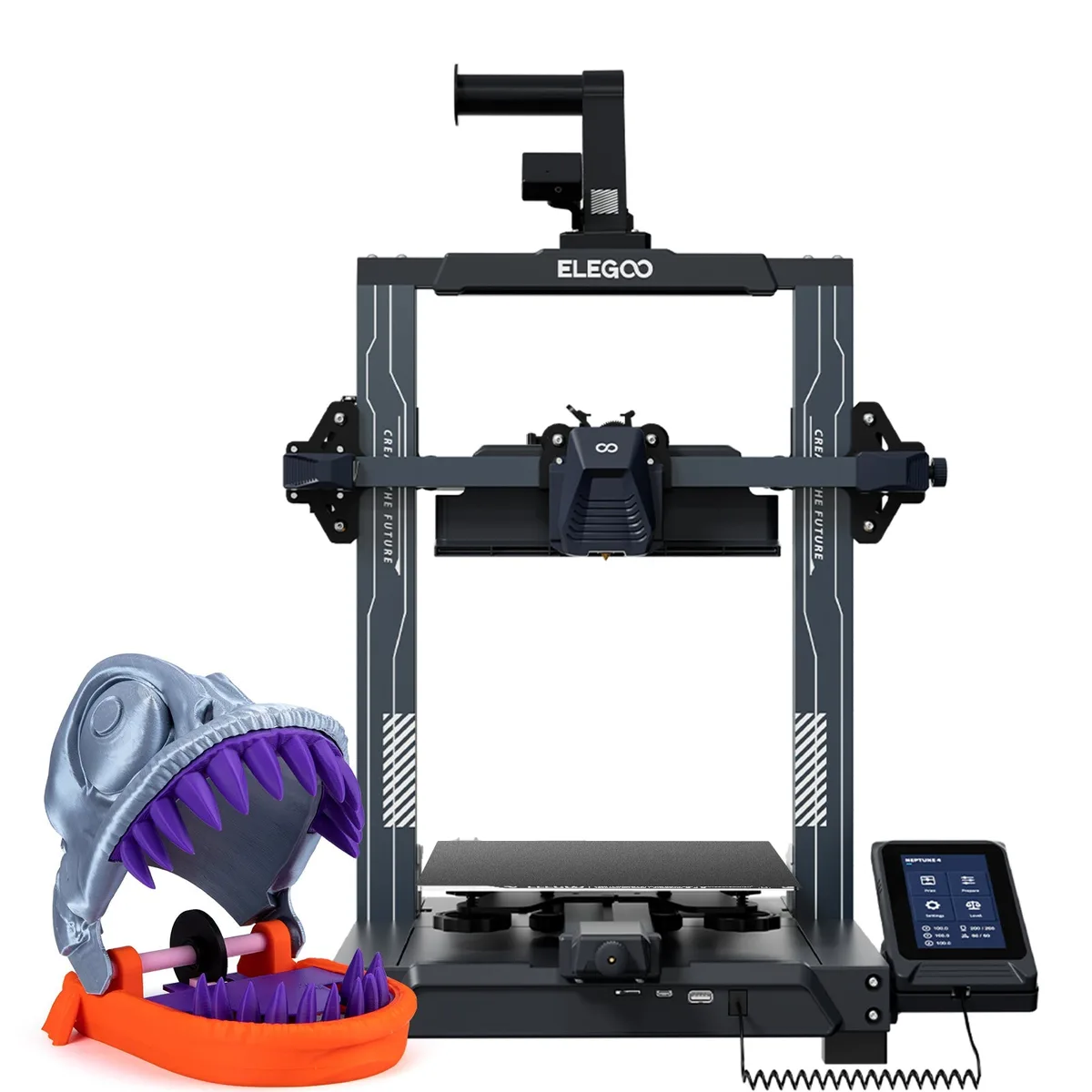
    ELEGOO Neptune 4 3D printer, official product image from ELEGOO
    Image: ELEGOO
    ELEGOO Neptune 4 Pro 3D printer, official product image from ELEGOO
    Image: ELEGOO

    Note that on November 17 ELEGOO’s page showed every Neptune 4 variant as sold out, while the Neptune 4 Pro Type-C version was available. These two share a 225 x 225 x 265 mm build volume, a 500 mm/s top speed, a 300 °C nozzle and Klipper firmware, according to ELEGOO’s pages. The Neptune 4 page also lists a 110 °C bed, 20,000 mm/s² acceleration and 121-point auto bed leveling. The Pro adds a segmented heatbed, with a center zone of 120 x 120 mm and peripheral zones that activate for larger models. ELEGOO recommends 250 mm/s even though the maximum is higher.

    ELEGOO Centauri 2

    ELEGOO Centauri 2 3D printer, official product image from ELEGOO
    Image: ELEGOO

    The newest model in this group, at $244 on the day we checked, marked down from $299 on the store page. ELEGOO lists a 256 mm cube, CoreXY motion, 500 mm/s speed, 20,000 mm/s² acceleration, a 350 °C nozzle and a die-cast aluminum frame. The page notes that its CANVAS multicolor add-on is sold separately, and a Combo version was listed on the store at $284, with $379 crossed out.

    Anycubic Kobra 4

    Anycubic Kobra 4 3D printer, official product image from Anycubic
    Image: Anycubic

    Anycubic lists a 260 mm cube, 600 mm/s maximum speed (300 mm/s default), 20,000 mm/s² maximum acceleration, a hardened steel 0.4 mm nozzle rated to 300 °C and a 100 °C bed. It also lists LeviQ 3.0 auto-leveling, a 720P camera and noise at or below 48 dB in standard mode. Multi-color printing requires the separate ACE 2 Pro, which is why a Combo exists (the Kobra 4 Combo with four filament colors was listed at $379 on the store page).

    How to choose, using only the specs

    • Most build space for the price: the Kobra 4, Centauri 2 and Neptune 4 all land in a similar range per liter.
    • Smallest footprint and Bambu’s ecosystem: the A1 mini.
    • Lowest ticket price: the Ender-3 V3 SE at $169, then the A1 mini at $199.
    • Highest nozzle ceiling: the Centauri 2 at 350 °C, versus 300 °C for the rest where listed.

    Remember that top speeds are marketing numbers. Several of these brands themselves recommend lower speeds for everyday printing. And none of this tells you how reliable a machine is after six months, how good the slicer feels or how good support is. Those matter, and we cannot speak to them without testing.

    Also on Amazon

    These Amazon.com listings are sold by each brand’s own official Amazon store. Amazon prices can differ from the brand sites, so check current price. These are Amazon affiliate links.

    We have not added Amazon links for the Bambu Lab A1 mini, ELEGOO Neptune 4 or Neptune 4 Pro, or the Kobra 4 printer alone, because we could not confirm a matching official-store listing.

    Sources and date checked

    All prices were re-checked against the official store pages on November 27, 2026, and the sale prices and crossed-out prices are as each store showed them. Since the November 17, 2026 check, the Ender-3 V3 SE is listed at $169 with $199 crossed out, and the Kobra 4 printer now shows $379 crossed out (the Combo remains listed at $379). Brand stores change prices frequently, so treat this as a snapshot and check the linked page for the current price.

  • Bambu Lab A1 vs A1 Mini

    Bambu Lab A1 vs A1 Mini

    Bambu Lab’s A1 and A1 mini are two versions of the same idea: a bed-slinger with automatic calibration, a direct-drive toolhead and an optional multi-color add-on. The big question for most buyers is whether the larger A1 is worth the extra money over the mini. This post compares the two using only what Bambu Lab publishes on its own store pages.

    How we compared: we have not printed on either machine. Every figure below was read from Bambu Lab’s official US store pages on November 17, 2026 (A1, A1 mini). Where a number is our own arithmetic, we label it as calculated. Prices change often, so check the store before you buy.

    Specs side by side

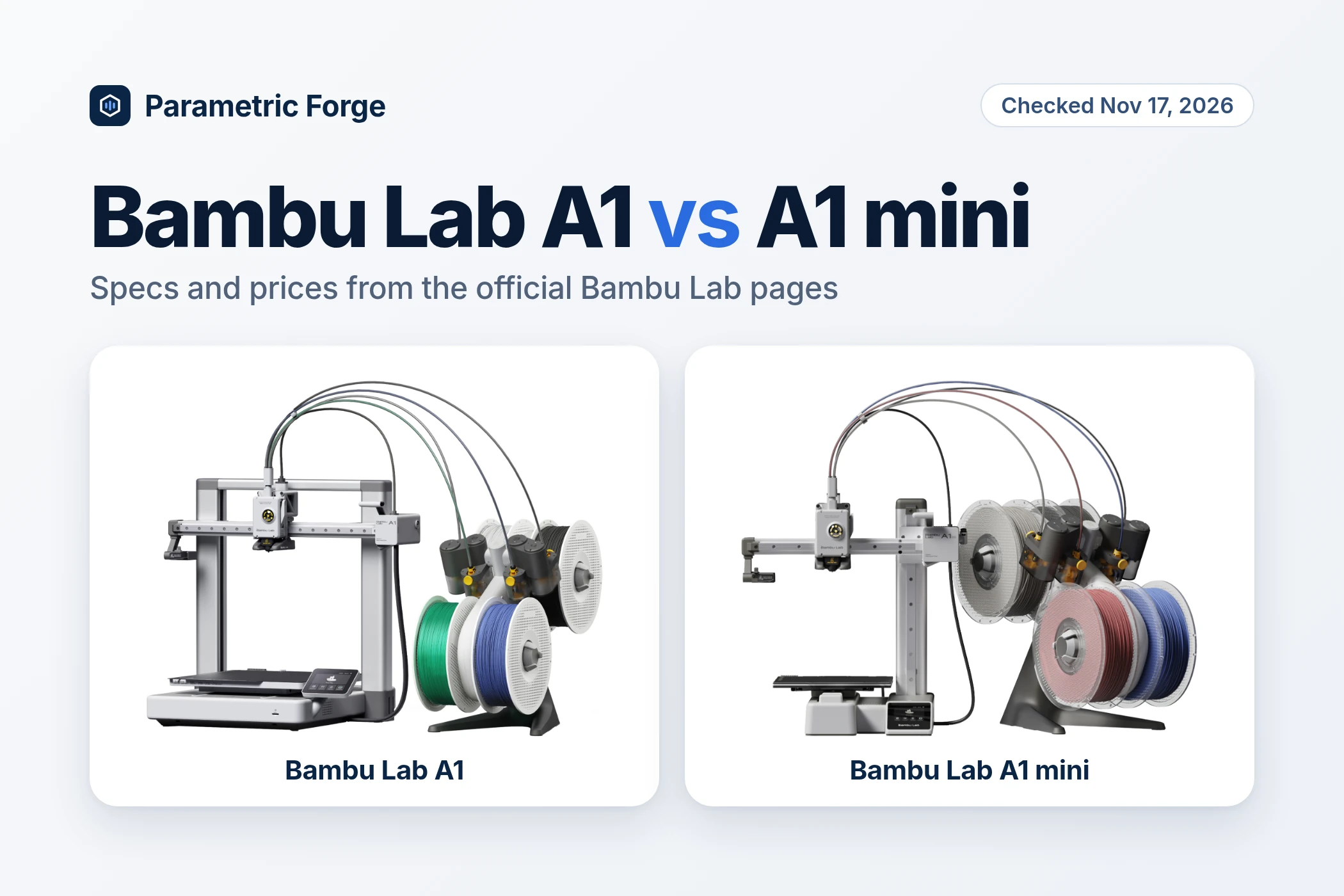
    Bambu Lab A1 3D printer, official product image from Bambu Lab
    Image: Bambu Lab
    Bambu Lab A1 mini 3D printer, official product image from Bambu Lab
    Image: Bambu Lab
    SpecBambu Lab A1Bambu Lab A1 mini
    Build volume (W x D x H)256 x 256 x 256 mm180 x 180 x 180 mm
    Hot endAll-metal, stainless steel nozzleAll-metal, stainless steel nozzle
    Max hot end temperature300 °C300 °C
    Nozzle size0.4 mm included; 0.2, 0.6, 0.8 mm available0.4 mm included; 0.2, 0.6, 0.8 mm available
    Max build plate temperature100 °C80 °C
    Max tool head speed500 mm/s500 mm/s
    Max tool head acceleration10,000 mm/s²10,000 mm/s²
    Included plateTextured PEITextured PEI
    Optional platesSmooth PEI, Dual-Texture PEI, High Temperature (Smooth PEI), Cool PlateSmooth PEI
    Filament listed as supportedPLA, PETG, TPU, PVAPLA, PETG, TPU, PVA
    Listed as not recommendedABS, ASA, PC, PA, PET, carbon or glass fiber reinforcedABS, ASA, PC, PA, PET, carbon or glass fiber reinforced
    Printer size465 x 410 x 430 mm347 x 315 x 365 mm
    Net weight8.3 kg5.5 kg
    Advertised noise level49 dB49 dB
    Store price for the printer alone, Nov 17, 2026$259$199 (page shows $219 as the typical price)
    Source: Bambu Lab US store product pages for the A1 and A1 mini, checked November 17, 2026. Prices were read during the store’s Black Friday sale banner and may change.

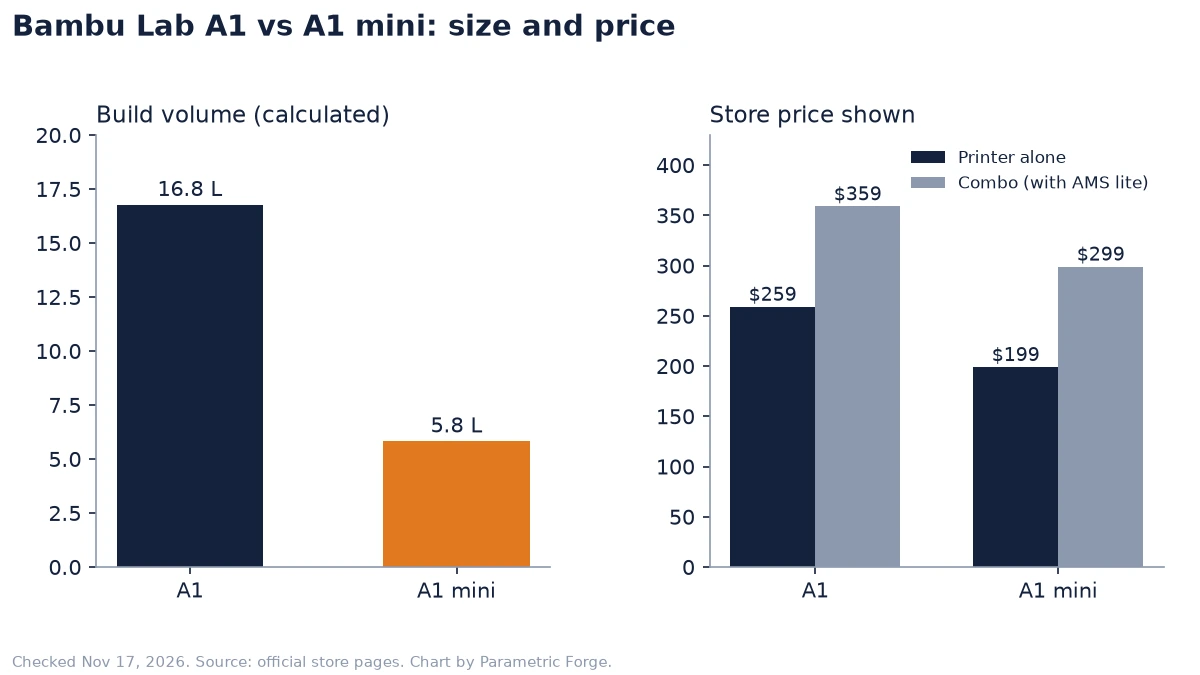
    The price row is for the printer on its own. Both pages also sell a Combo version that adds Bambu’s AMS lite multi-color unit. On our check date the A1 Combo was listed at $359 and the A1 mini Combo at $299.

    Where the two are identical

    The overlap is bigger than you might expect. Bambu lists the same top tool head speed (500 mm/s), the same acceleration (10,000 mm/s²), the same 300 °C hot end limit and the same nozzle options for both. Both pages also list the same sensor suite: filament run-out, filament odometry, power loss recovery and a filament tangle sensor. Both include a low frame rate camera with timelapse support, and both ship with a textured PEI plate.

    In practice, that means the choice is not about raw motion specs on paper. Bambu is selling the same motion platform at two sizes.

    Where they differ

    Build volume

    The A1 offers 256 mm on every axis. The mini offers 180 mm. Converted to volume, that is about 16.8 liters versus 5.8 liters. That is our own calculation from Bambu’s listed dimensions (256 x 256 x 256 = 16,777,216 mm³ and 180 x 180 x 180 = 5,832,000 mm³), but the ratio is large: the A1’s build space is roughly 2.9 times the mini’s. If you print helmets, enclosures, tool holders or anything tall, the mini will force you to split parts. If you mostly print small brackets, figurines or desk accessories, 180 mm goes further than it sounds.

    Bed temperature

    The A1’s plate tops out at 100 °C and the mini’s at 80 °C. Bambu lists PLA, PETG, TPU and PVA as supported on both, so this difference may not matter for those materials. It is still a spec gap worth knowing about if you like to run PETG on a hotter bed.

    Size and weight

    The mini is listed at 5.5 kg and 347 x 315 x 365 mm. The A1 is listed at 8.3 kg and 465 x 410 x 430 mm. If your desk or shelf is tight, the mini’s footprint is a real advantage. The A1 needs noticeably more room, especially around its moving bed.

    Plate options

    The A1 page lists five plate types (Textured PEI included, plus Smooth PEI, Dual-Texture PEI, High Temperature and Cool Plate). The mini’s page lists two. If you want to experiment with different surface finishes, the A1 has more official choices.

    Price

    On our check date, the A1 on its own was listed at $259 and the mini at $199, a gap of $60. Using the build volume numbers above, the A1 works out to roughly $15 per liter of build space and the mini to roughly $34 per liter (calculated by us from list price and volume, rounded). The bigger machine is the better deal per unit of space, though the mini is the lower entry price.

    Charts comparing build volume and store price of the Bambu Lab A1 and A1 mini, checked November 17, 2026
    Chart: Parametric Forge. Prices checked November 17, 2026 from official store pages.

    Who each one suits, based on the specs

    • Choose the A1 if you want room to grow, print larger parts, or want the hotter 100 °C bed and the wider choice of plates.
    • Choose the A1 mini if you have limited space, print small items, or want the lowest entry price in Bambu’s lineup of these two models.

    Neither printer is listed as suited to ABS, ASA, nylon or carbon fiber filaments, since Bambu marks those as not recommended. If you want those materials, you would need to look at an enclosed printer instead. We cover that kind of comparison separately.

    What we cannot tell you

    Spec sheets do not show print quality, reliability over time or how loud a machine sounds in your room. We have not tested either printer, and we are not going to guess. For that kind of information, read owner reports and the brand’s own support pages. Bambu also notes on its A1 page that units sold after January 30, 2024 are not from the batch involved in an earlier heatbed cable recall, which is worth reading about on the store page if you are shopping.

    Where to buy

    We link to the official pages so you can confirm current pricing and bundles: Bambu Lab A1 and Bambu Lab A1 mini.

    The brand also runs official stores on Amazon.com. These listings are sold by Bambu Lab’s own Amazon store, and the price can differ from the official site, so check current price: Bambu Lab A1 (printer alone) and Bambu Lab A1 mini Combo. Both are Amazon affiliate links. We have not linked the other variants because we could not confirm an official-store listing for each.

    Prices were re-checked against both official store pages on November 17, 2026. The re-check matched our first read earlier the same day: A1 $259 (store shows $299 crossed out), A1 Combo $359, A1 mini $199 (store shows $219 crossed out) and A1 mini Combo $299. Specs were read from the same pages. We will refresh this post when Bambu Lab updates its pages.